
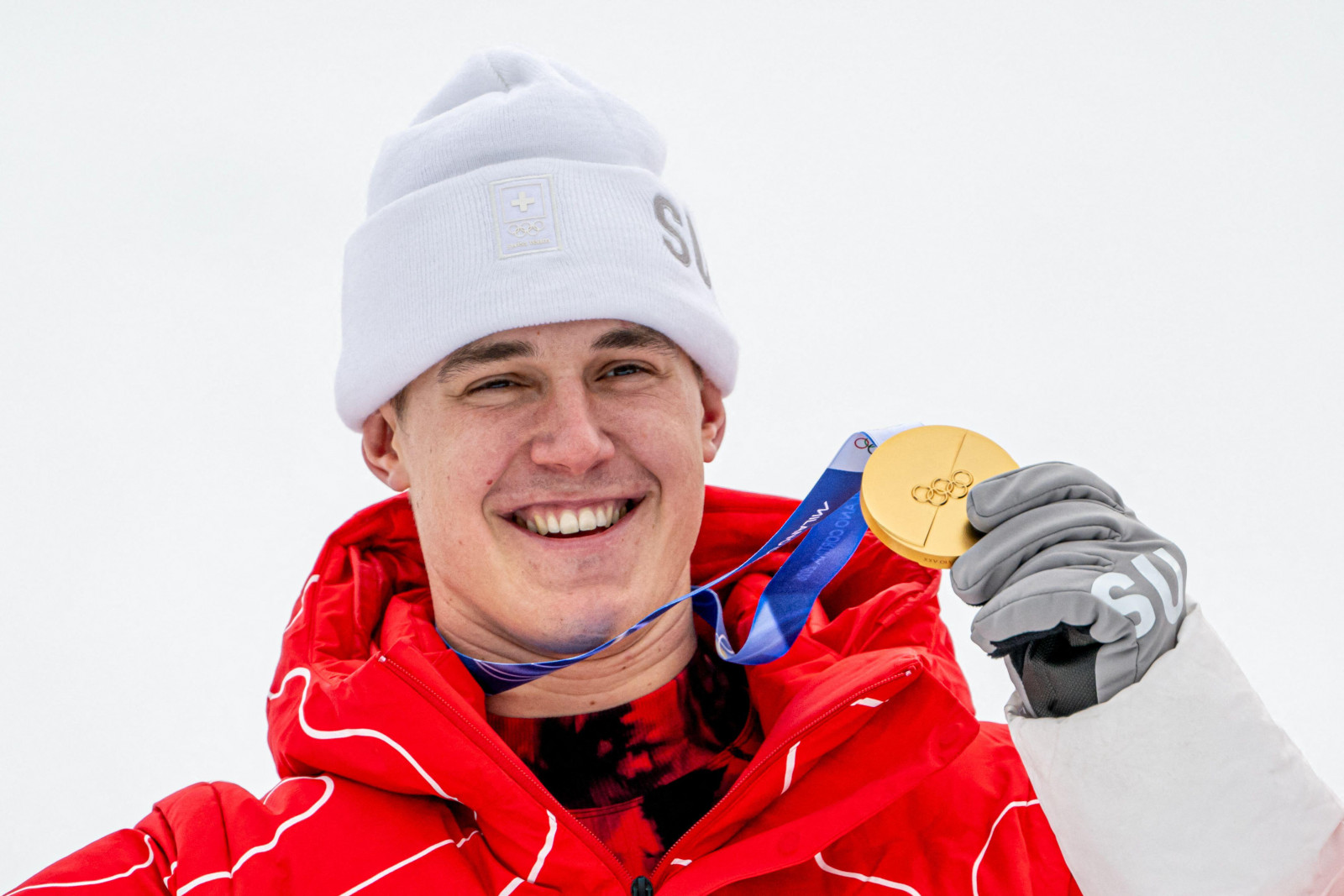
Three races, three Olympic titles. Franjo von Allmen completed a historic treble Wednesday morning by winning the Super-G on the Stelvio in Bormio, clocking 1:25.32. The 24-year-old from Bern, already crowned in downhill and team combined, joins Jean-Claude Killy (Grenoble 1968) and Toni Sailer (Cortina 1956) as the only male alpine skiers to win three Olympic titles at a single Games. American Ryan Cochran-Siegle, true to his Olympic Super-G form, claimed silver (+0.13), while Marco Odermatt salvaged bronze (+0.28) that doesn't mask his frustration. Nils Allègre, admirable forerunner with bib 1, fell three hundredths short of the podium—a heartbreak matching his exceptional week.
```- 🥇 Franjo VON ALLMEN (SUI) - 1:25.32
- 🥈 Ryan COCHRAN-SIEGLE (USA) - 1:25.45 (+0.13)
- 🥉 Marco ODERMATT (SUI) - 1:25.60 (+0.28)
Von Allmen's 3rd Olympic gold Milano-Cortina 2026
Von Allmen, the supersonic Swiss
The adjective "historic" gets overused in sports. Not this time. In five days on the Stelvio, Franjo von Allmen has pushed the limits of what an alpine skier can accomplish at a single Olympic Games. Gold in downhill Saturday, gold in team combined Monday with Tanguy Nef, gold in Super-G Wednesday: the Bernese is the first man to complete the downhill-Super-G double at the Games, a feat only Michaela Dorfmeister had achieved among women, at Turin in 2006.
He's also the first Swiss crowned in men's Olympic Super-G—a statistic that speaks volumes about the magnitude of his performance in a country that has dominated speed skiing in recent decades without ever claiming this specific title. With three Olympic golds, he joins Vreni Schneider as Swiss-Ski's only representatives to total as many Games titles.
The day before the race, von Allmen had measured his ambitions with disarming humility: "I don't really feel like the star of alpine skiing here at the Games. For a third gold medal, all the planets would have to align."
They did. Starting with bib 7 on a course still in excellent condition, the Swiss delivered a run of absolute mastery, combining risk-taking and surgical precision on a demanding course—from the San Pietro jump to the long off-camber turn of the Carcentina. Thirteen hundredths ahead of Cochran-Siegle, who had briefly led: a comfortable margin in this discipline where everything is decided by razor-thin margins.
- Franjo VON ALLMEN (SUI) - 1:25.32
- Ryan COCHRAN-SIEGLE (USA) - 1:25.45 (+0.13)
- Marco ODERMATT (SUI) - 1:25.60 (+0.28)
- Nils ALLÈGRE (FRA) - 1:25.63 (+0.31)
- Raphael HAASER (AUT) - 1:25.89 (+0.57)
- Giovanni FRANZONI (ITA) - 1:25.95 (+0.63)
- Vincent KRIECHMAYR (AUT) - 1:26.10 (+0.78)
- Fredrik MOELLER (NOR) - 1:26.12 (+0.80)
- Stefan ROGENTIN (SUI) - 1:26.14 (+0.82)
- Alexis MONNEY (SUI) - 1:26.22 (+0.90)
Cochran-Siegle: the Olympic Super-G specialist
Some athletes are transformed by major championships. Ryan Cochran-Siegle is one of them. At Beijing in 2022, the Vermonter claimed Super-G silver, four hundredths behind Matthias Mayer. Four years later, here he is on the second step again, this time thirteen hundredths behind von Allmen. Two Games, two silvers in the same discipline: remarkable consistency for a skier often in the background on the World Cup circuit.
Family history adds an emotional layer. His mother Barbara Cochran won Olympic slalom gold at Sapporo in 1972, and Ryan is the sixth Olympian from this Vermont dynasty. One detail hasn't escaped observers' notice: his only World Cup Super-G victory dates back to 2020… at Bormio. The terrain clearly suits him.
Starting with bib 3, Cochran-Siegle briefly led the race before von Allmen relegated him. When Odermatt, bib 10, made a small error mid-course that prevented him from taking silver, the American's position solidified. An ideal scenario for a 33-year-old skier who had defied predictions after fracturing a cervical vertebra at Kitzbühel in 2021.
Odermatt: bronze tinged with disappointment
Marco Odermatt's Olympic record at these Milan-Cortina Games is taking shape in shades of gray. Fourth in downhill, silver medalist in team combined with Loïc Meillard, here he is with Super-G bronze—a discipline where he's won the crystal globe three consecutive seasons. Two medals (one silver, one bronze) where many expected him atop every podium.
On course, Odermatt delivered an inconsistent run. Very fast in the upper section—over 107 km/h at the speed checkpoint—he made a small mistake after San Pietro that knocked him off ideal rhythm. Visibly frustrated at the finish, the Nidwalden native saw Olympic gold slip away once more, gold that would have crowned his circuit dominance. Giant slalom remains to set things right.
4th - 1:25.63 (+0.31) - 3 hundredths from podium
💬 "I'm furious. I'm gutted because my career is always a bit like this. There are guys who always have the hundredths on their side, and I don't."
Olympic Record: 8th downhill, 4th Super-G, 5th team combined (+0.13 from bronze)
Allègre: heartbreak for a man who gave everything
Three hundredths. Thirty thousandths of a second. That's the infinitesimal gap separating Nils Allègre from an Olympic Super-G medal. The Serre-Chevalier skier, bib 1, had opened the Stelvio with a remarkably clean run—focused at the top, economical on the way down, no major errors—to post 1:25.63. A time that would hold against virtually the entire field, except the three men ahead of him.
"I'm furious. I'm gutted because my career is always a bit like this. There are guys who always have the hundredths on their side, and I don't," he confided to France 2, voice charged with emotion. The frustration is legitimate: a regular in World Cup fourth places, Allègre had already finished fourth in downhill and Super-G at Val Gardena this season, respectively four and seven hundredths from the podium. At these Games, he adds eighth in downhill, fifth in team combined (thirteen hundredths from bronze), and now this cruel fourth place.
Yet stepping back, Allègre's Games are a success. Three events, three top-10s on the circuit's most demanding course—Bormio's Stelvio—metronome-like consistency at the highest world level. French audiences discovered a reliable, committed competitor capable of playing leading roles against the world's best. The absence of "hardware" shouldn't obscure the essential: Allègre genuinely fulfilled his Olympic contract.
"I have a mix of great pride in my entire week and great disappointment," he summarized lucidly. Hundredths aren't always fair. But talent and commitment never lie.
The course and conditions: a two-speed Super-G
The Stelvio course was unanimously praised: technical, demanding, with the spectacular San Pietro jump (about 50 meters) and the treacherous Carcentina as tipping points. A true championship Super-G that separated racers on their ability to combine speed and line-reading.
But the race was marked by rapidly evolving conditions. Under beautiful morning sunshine, light gradually declined and the course noticeably deteriorated with successive passes. Early bibs benefited from firmer snow and better visibility—an advantage that Allègre (bib 1), Cochran-Siegle (3), and von Allmen (7) clearly exploited. The top four all wore bibs under 10.
Conversely, skiers starting later struggled to find rhythm on an increasingly rutted course. Only Vincent Kriechmayr (bib 15, 7th) managed to distinguish himself in the second half of the start field.
- 🇨🇭 Swiss dominance: 4 in top 10 (von Allmen, Odermatt, Rogentin, Monney)
- 💔 Dominik Paris DNF: Lost ski in opening turns (setup error)
- 🇮🇹 Franzoni 6th: Confirms after downhill silver
- 🇫🇷 Alban Elezi Cannaferina 15th: 22 years old, very honorable Olympic debut
- 📉 Mattia Casse 24th: World Cup Super-G leader, never found rhythm
- 🚫 3 DNF: Paris (ITA), Alphand (FRA), Radamus (USA)
Race developments
Swiss dominance is this race's collective achievement: four representatives in the top 10 (von Allmen, Odermatt, Rogentin, Monney), a pattern of power reminiscent of the Austrian team's glory years in the 2000s.
Dominik Paris, seven-time World Cup winner on this Stelvio he knows by heart, experienced a nightmare. The "King of Bormio" lost his ski in the opening turns, victim of a probable setup error. For someone who had claimed his first Olympic bronze in downhill Saturday, the disillusionment is immense.
Giovanni Franzoni (6th) confirms his status as Italian speed skiing's new force after downhill silver. Mattia Casse (24th), World Cup discipline leader, never found his rhythm.
On the French side, Alban Elezi Cannaferina (15th at 22) recorded a very honorable result for his first individual Olympic speed event. Nils Alphand wasn't so fortunate: he's among the three DNFs with Paris and American Radamus.
- 🥇 Downhill (February 7): 1:51.61
- 🥇 Team Combined (February 9): With Tanguy Nef
- 🥇 Super-G (February 11): 1:25.32
Joins Killy (1968) and Sailer (1956): Only skiers with 3 golds at same Games
1st men's downhill-Super-G double in Olympic history
1st Swiss Olympic men's Super-G champion
What's next?
Can von Allmen continue his haul? The alpine program still offers giant slalom, a discipline where he's not favored but where nothing can be ruled out anymore. Odermatt, precisely, is expected as the undisputed boss there—where he claimed his first Olympic gold in Beijing. Revenge may come between the blue gates.
As for Allègre, he can leave Bormio with his head held high, confident he skied at his best level across all three speed events. Hundredths aren't always fair. But talent and commitment never lie.
- February 14: Women's giant slalom (Cortina)
- February 15: Men's giant slalom (Bormio) - Odermatt favorite
- February 16: Women's slalom (Cortina)
- February 17: Men's slalom (Bormio)
- 🥇🥇🥇 Von Allmen: Historic treble (downhill, team combined, Super-G)
- 👑 Joins Killy & Sailer: 3 golds at same Olympic Games
- 🥈 Cochran-Siegle: 2nd consecutive Olympic Super-G silver (2022, 2026)
- 🥉 Odermatt: Frustrated bronze, 3x Super-G globe winner
- 💔 Allègre 4th: 3 hundredths from podium, remarkable week
- 🇨🇭 Switzerland: 4 in top 10
- 🇮🇹 Franzoni 6th: Confirms after downhill silver
- 😔 Paris DNF: Lost ski, setup error
- 🇫🇷 Elezi Cannaferina 15th: Strong performance at 22
- ⛷️ Conditions: Early bibs advantaged