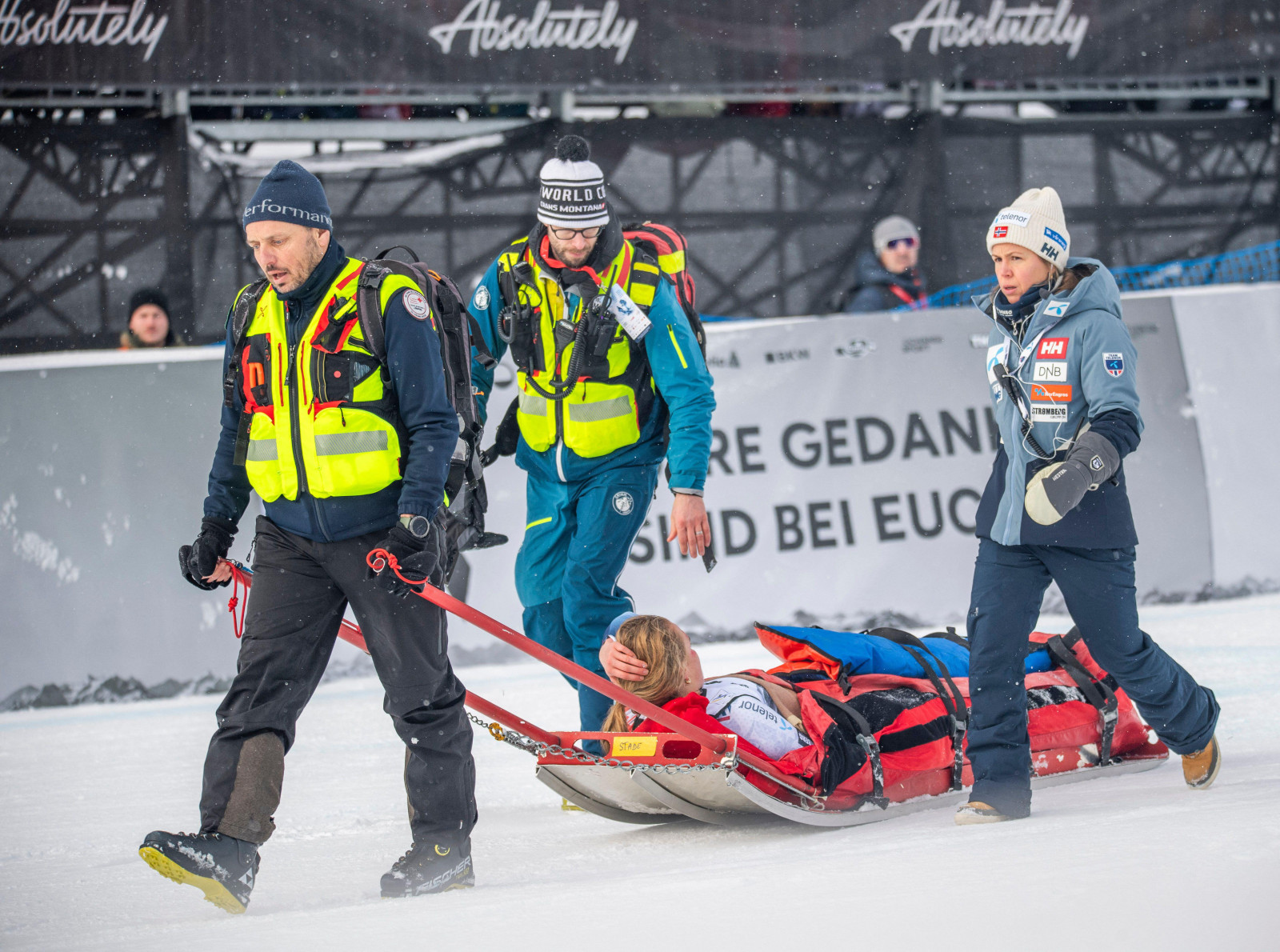
The women's downhill in Crans-Montana was cancelled on Friday, January 30, after only six starters and three heavy crashes, including that of Lindsey Vonn. One week before the Milano-Cortina Olympics, the incident reignites the debate on managing dangerous conditions in alpine skiing.
```The Facts: Three Crashes in Six Starts
The race turned to nightmare from the first runs. Of the six racers who started, three ended up in the safety nets. Austria's Nina Ortlieb (bib 1) crashed at the top of the course, in an area that would prove particularly treacherous. Norway's Marte Monsen then violently hit the nets near the finish and had to be evacuated by sled, her face bloodied.
The sixth and final starter, Lindsey Vonn, crashed in the same sector as Ortlieb. The 41-year-old American star, favorite for Olympic gold, lost her balance on landing a jump before ending up in the nets, her airbag deploying. After remaining on the ground for several minutes, Vonn was able to ski down but stopped repeatedly to hold her left knee, grimacing in pain. She was then airlifted to hospital for examinations, casting doubt on her participation in the Games starting February 6.
Between these crashes, only three racers crossed the line: Americans Jacqueline Wiles and Corinne Suter, along with France's Romane Miradoli. Shortly before 11am, nearly an hour after the first start, organizers announced the race's definitive cancellation.
- 6 starters total before cancellation
- 3 crashes: Ortlieb (AUT), Monsen (NOR), Vonn (USA)
- 3 finishers: Wiles (USA, leader), Suter (SUI), Miradoli (FRA)
- Elimination rate: 50%
- Monsen: Evacuated by sled, bloodied face
- Vonn: Airlifted, left knee pain
- Cancellation: 56 minutes after first start
Deteriorating Conditions and Near-Zero Visibility
Weather conditions played a decisive role in this fiasco. Snowfall intensified throughout the morning, drastically reducing visibility. "You can't see, and it's bumpy everywhere," said Romane Miradoli, one of the few to finish. Asked if it was dangerous, she simply added: "We just couldn't see well."
Peter Gerdol, FIS race director, justified the cancellation by this progressive deterioration: "In recent hours, visibility deteriorated more and more. Athletes could no longer recognize the correct line."
Added to this was a snow problem. Higher than expected temperatures made the snow unstable and soft, increasing the risk of losing control in fast sections. Wolfgang Maier, German alpine director, nevertheless nuanced: "The preparation isn't bad, but not quite uniform, it's an extreme challenge." He attributed the crashes to "individual skiing errors" rather than course preparation.
- Visibility: Poor, snowfall
- Snow: Unstable and soft (high temperatures)
- Course: Bumpy, uneven preparation
- Deterioration: Progressive throughout morning
"We just couldn't see well" — Romane Miradoli (FRA)
The Crucial Role of the Forerunner, Frontline Witness
One element deserves particular attention: the opinion of the forerunner who descended the course after Vonn's crash. According to several sources, this forerunner reportedly spoke against continuing the race. This testimony carries paramount importance: unlike organizers or FIS officials who observe from the side of the course or control screens, the forerunner is the only one to actually test the course and visibility in the exact competition conditions, just minutes before the competitors, and at each race resumption if the interruption has been long.
Controversy Over Decision to (Re)Start Race
Management of this situation sparked criticism within the field. Germans Kira Weidle-Winkelmann ("This is ridiculous") and Emma Aicher, along with Italy's Laura Pirovano, athletes' representative, expressed their discontent. Pirovano apparently wasn't even consulted before the decision to give the start, raising questions about the effective role of racers' representatives in such situations. However, these opinions should be put into perspective, as many spoke in favor of resuming the race. Repeated delays, frustration, and cancelled training sessions were not necessarily the best advisors.
This point raises an essential procedural question. In case of serious doubt about a race's risks, standard practice calls for collective consultation including athletes' representatives. While the final decision rests with FIS officials, this concertation allows collective assessment of dangers and avoids reckless risk-taking. The apparent absence of this consultation in Crans-Montana raises questions. However, since the FIS chose safety, it would be excessive to reproach them for anything on this matter.
Alpine skiing history has known precedents where, lacking dialogue, skiers had to collectively refuse to start to force the FIS to cancel races deemed too dangerous. These extreme situations, observed notably in the 1990s and 2000s, had led to establishing consultation protocols. One would prefer not to return to such confrontations. In light of alpine skiing history, the decision was the best one.
Opinions nevertheless remain divided among athletes. Jacqueline Wiles, who was leading the race when it was cancelled, stated: "It didn't feel like anything crazy" regarding her own run, while understanding the final decision: "It's a tough day. We should protect everyone."
Aksel Lund Svindal, two-time Olympic champion and Lindsey Vonn's coach this season, acknowledged that "going ahead with the race this morning was a tough decision for organizers," while underlining the Crans-Montana course's dangers.
Critical
- Kira Weidle-Winkelmann (GER): "This is ridiculous"
- Emma Aicher (GER) and Laura Pirovano (ITA): Unhappy with FIS decision
- Pirovano (athletes' rep): Reportedly not consulted
- Forerunner: Against continuing race
Understanding
- Jacqueline Wiles (USA): "Didn't feel like anything crazy" but "should protect everyone"
- Nina Ortlieb (AUT): "When the best skier, Lindsey Vonn, also fails, it shows the course is currently very demanding"
- Aksel Lund Svindal: "Tough decision for organizers"
Single Training Run: An Aggravating Factor
The context preceding the race also fueled questions. Downhillers benefited from only one training run before the race, the second timed practice scheduled Thursday morning having been cancelled for lack of sufficient time to prepare the course. Moreover, this single training had taken place on a shortened course, with racers starting Friday from a reserve start.
This limited preparation on a notoriously difficult course, combined with uncertain weather conditions, already raised questions about the prudence to adopt.
Justified Cancellation, But Late
Fundamentally, no one contests the necessity of cancelling the race. With a 50% elimination rate (three crashes in six starts) and conditions that kept deteriorating, continuing the race would have been irresponsible. Athletes' safety must prevail, especially one week before the Olympics.
The divisive question concerns more the timing of this decision. Should the initial start have been given in these conditions? Should cancellation have occurred after the second crash rather than waiting for the third? Nina Ortlieb, herself a crash victim, delivered revealing testimony: "When the best skier, Lindsey Vonn, also fails, it shows the course is currently very demanding."
It's regrettable that three severe crashes and nearly an hour were needed to reach consensus on cancellation. Marte Monsen's injuries and Lindsey Vonn's knee pain, days before the Games, might have been avoided with an earlier decision, particularly by considering the forerunner's opinion from the start.
- ~10:04am: Nina Ortlieb start (bib 1) → Crash top of course
- Interruption 1: 30 minutes after Ortlieb crash
- ~10:30am: Marte Monsen (NOR) → Violent crash near finish, sled evacuation
- Interruption 2: Monsen medical treatment
- ~10:35am: Jacqueline Wiles (USA) → Finish (leader)
- ~10:37am: Corinne Suter (SUI) → Finish
- ~10:40am: Romane Miradoli (FRA) → Finish
- ~10:45am: Lindsey Vonn (bib 6) → Crash same sector as Ortlieb
- Interruption 3: Forerunner descends, negative opinion
- ~11:00am: Definitive cancellation (56 min after start)
Heavy Emotional Context
This Crans-Montana race took place in particularly emotionally charged circumstances. The Valais resort had been struck a month earlier by a deadly fire in the Le Constellation bar, which killed 40 people, mostly young people, and injured 116 others on New Year's Eve.
As a sign of respect, all festive activities of the World Cup weekend had been cancelled, the event limiting itself to races and spectator areas along the slopes. The atmosphere was meant to be somber, far from competitions' usual carefree spirit.
What Consequences for the Olympics?
Lindsey Vonn's health status crystallizes all concerns. The women's Olympic downhill is scheduled for February 8 in Cortina d'Ampezzo, just nine days away. Vonn, who has 84 World Cup victories and won Olympic gold in 2010 in Vancouver, was making a spectacular comeback after six years away and right knee surgery (partial titanium prosthesis). She had earned five podiums in five downhills this season, including two victories.
Her coach Aksel Lund Svindal indicated she was taken to hospital for precautionary examinations: "She has some pain, so it's better to have checks. The physio did checks that seemed OK, but there were things he wasn't 100% sure about, so it was good to have them checked."
Beyond Vonn, Marte Monsen's condition, evacuated on stretcher, also remains concerning for Norway.
- Age: 41 years
- Record: 84 WC wins, 2010 Vancouver Olympic gold
- Comeback: After 6 years retirement, titanium knee prosthesis 2024
- 2025-26 Season: 5 podiums/5 downhills (2 wins, 1 second, 2 thirds)
- Leader: WC downhill standings before crash
- Injury: Left knee (the other knee!)
- Olympics: Downhill Feb 8 Cortina (in 9 days)
- Cortina: 12 WC wins, favorite terrain
Vonn was to be one of Milano-Cortina Games' stars
Conclusion: A Difficult Balance Between Sport and Safety
The Crans-Montana incident illustrates the complexity of managing borderline conditions in high-level alpine skiing. Organizers, FIS, and athletes must constantly arbitrate between spectacle, tight schedules, sporting stakes, and competitors' safety.
The final cancellation was indisputably the right decision. But the episode recalls the crucial importance of effective communication between all actors—organizers, officials, athletes' representatives, and especially forerunners who test the course in real conditions—and the necessity of preventive rather than reactive decisions.
In a sport where risks are inherent to the discipline, it's unfortunate that severe crashes are sometimes needed to reach consensus on stopping a race. One week before the Olympics, this event poses an essential question: how far can limits be pushed before it's too late?
Crans-Montana
- Saturday January 31: Women's Super-G (weather permitting)
- Sunday February 1: Men's downhill
Milano-Cortina 2026 Olympics
- February 6: Opening ceremony
- February 8: Women's downhill (Cortina d'Ampezzo)
- February 15: Women's Super-G
- 3 crashes / 6 starts: 50% elimination rate
- Vonn injured: Left knee, Olympic participation uncertain
- Monsen evacuated: Sled, bloodied face
- Conditions: Zero visibility, unstable snow
- Single training: Limited preparation
- Late cancellation: 56 minutes after start
- Forerunner role: Only reliable witness of conditions
- Controversy: Why start the race?
- Consensus: Cancellation justified, timing questionable
- 9 days before Olympics: Catastrophic timing