
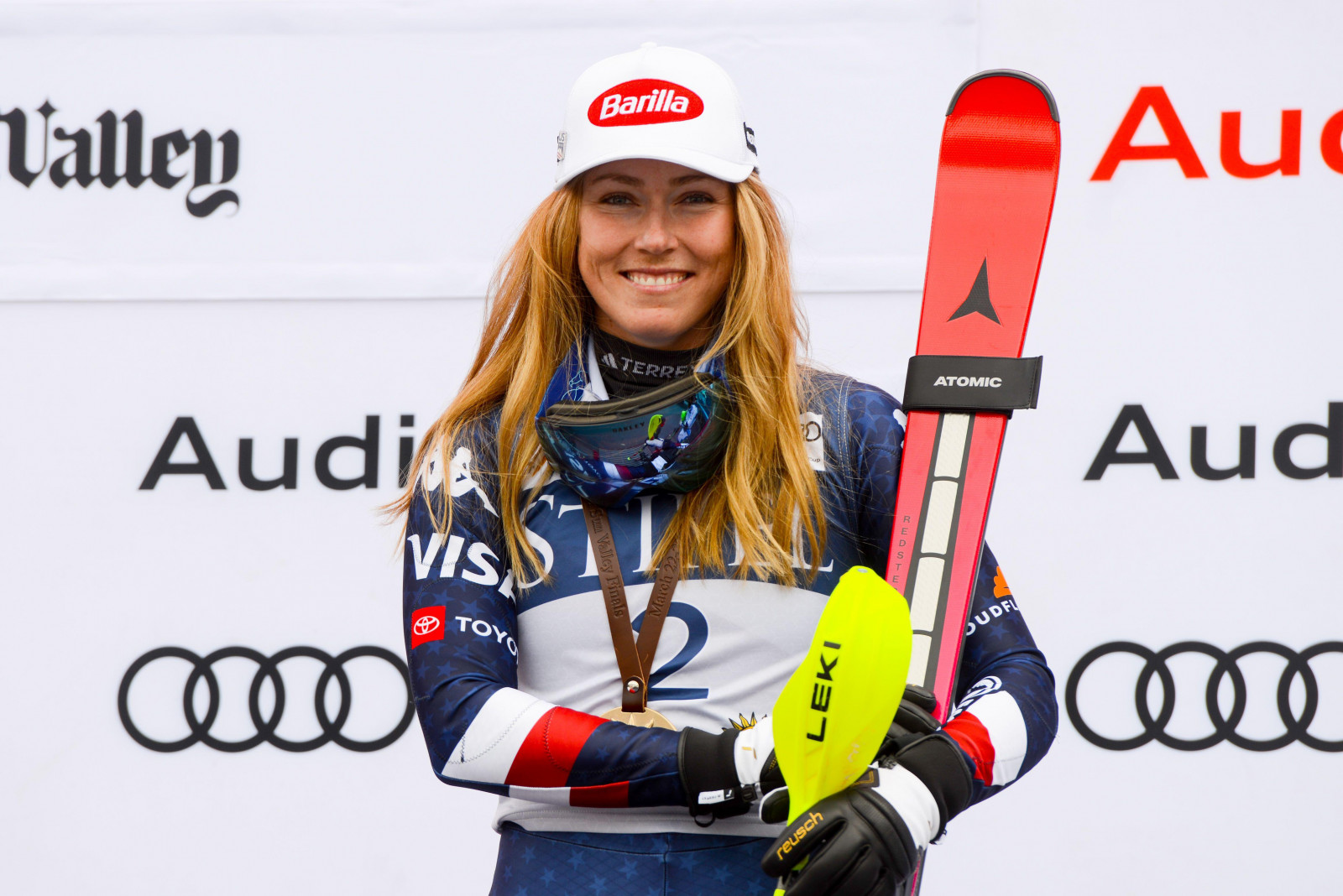
Copper Mountain gave women’s slalom its first real reference point of the winter. In a discipline billed as one of the most open of this Olympic season, Mikaela Shiffrin chose the simplest possible answer: ski faster than everyone else, twice. A clinical first run, a controlled second, and in the end a win with more than a second and a half in hand. Behind her, Lena Dürr and Lara Colturi rounded out a podium that says as much about the future as it does about the day itself.
Shiffrin’s win is about control, not damage limitation
After a frustrating giant slalom, Shiffrin needed a clean slalom. She produced exactly that. Her first run was textbook — direct, precise, without theatrical risk, good enough for the fastest time in 52.94. The second run, on a surface growing more unforgiving, was built in the same register: composed, measured, letting the skis do the work rather than forcing the line.
She stopped the clock in 1:48.75, with the best time in the first run and the second-fastest in the second (55.81). In a field where gaps are usually counted in tenths, a final margin of 1.57 seconds over her closest rival feels almost old-fashioned. The message is not subtle: when conditions align and the intent is clear, slalom still belongs to Shiffrin.
1. Mikaela Shiffrin (USA) — 1:48.75 (1st in Run 1, 2nd in Run 2)
2. Lena Dürr (GER) — 1:50.32 (+1.57), 3rd-fastest in Run 2
3. Lara Colturi (ALB) — 1:50.60 (+1.85), podium built on a strong first run
Dürr, the constant in a shifting field
At 34, Lena Dürr continues to play a role that is easy to overlook and hard to replace. Her race in Copper fits perfectly into that pattern. Ninth after the first run (+1.28), she produced the third-fastest time in the second to climb seven places and secure another podium.
Her skiing is not built on spectacular moments. It lives off something more durable: clean edge work, a steady upper body, a refusal to panic when the course tightens. In a field full of streaks and swings, Dürr offers something different — a line of stability.
Colturi, a podium that builds more than it celebrates
For Lara Colturi, this third place is less about fireworks and more about foundation. Fourth after the opening run (+0.74), she slipped slightly with the 14th time in Run 2, but managed the risk well enough to stay on the podium. It is not the statement win that Levi seemed to promise, but it is the kind of result that builds a season.
Colturi is not yet dictating the discipline, but she has moved firmly into the inner circle — close enough to Shiffrin to matter, and resilient enough not to disappear after a single imperfect run. In an Olympic winter, that combination can be worth as much as a one-off victory.
Starting the second run with the 28th time from the opening leg (+3.62), France’s Caitlin McFarlane produced the fastest second run of the day. Her 55.63 was 0.18 quicker than Shiffrin’s effort on the same course and lifted her to 12th overall.
For a French technical squad in reconstruction, that single run matters more than the finishing position alone. It suggests there is more depth in the pipeline than the rankings have shown so far.
The field behind the podium
Behind the top three, Copper also mapped out the strength of the main national blocks. Wendy Holdener (4th) and Camille Rast (10th) underlined Switzerland’s depth, even if Holdener’s second run — 25th time — reminded everyone how quickly the balance can shift.
Sweden placed Anna Swenn Larsson in 5th and Sara Hector in 9th: no headline-grabbing performance, but a pair of results that add up over the course of a season. Austria, with Katharina Liensberger (6th), Katharina Truppe (7th) and Katharina Gallhuber (11th), finally looked more like its old self in a discipline it once used to dominate by default.
Sweden: Swenn Larsson (5th) and Hector (9th) deliver a solid double act, the kind that keeps a team present near the sharp end without burning energy too early.
Norway: Stjernesund climbs to 14th with a decent second run, while Holtmann’s DNF in Run 2 leaves a sense of unfinished business — the potential is there, the execution not quite.
Finland: no major score this time, but another race of experience on North American snow for a young group that will matter again when Levi comes back into view.
The ones who missed and the story that follows
One notable absence from the front of the results sheet is Zrinka Ljutic. Tipped as one of Shiffrin’s main rivals for the slalom globe, she never quite found the extra gear needed to turn Copper into a reference race. There was no dramatic failure — just not enough of the sharp, vertical skiing she has shown elsewhere.
It is a delay, not a derailment. But in a winter where Shiffrin can still choose her moments, where Colturi is quietly stacking podiums, and where experienced names like Dürr refuse to fade, each missed opportunity will have weight later in the season.
What Copper really changes
This slalom does not close any doors. It reopens several. Shiffrin proved she can still step out of the pack and run a race from the front when the conditions suit her. Colturi confirmed that she belongs in the core group hunting for the globe. Dürr showed, once again, that experience and composure are still currencies that count in a chaotic discipline.
Add McFarlane’s statement run, the collective strength of Switzerland, Sweden and Austria, and Copper sends a clear message: women’s slalom in 2025/26 will not be a one-character drama. Shiffrin has the lead role again — but the cast around her is far too strong to be reduced to background noise.