
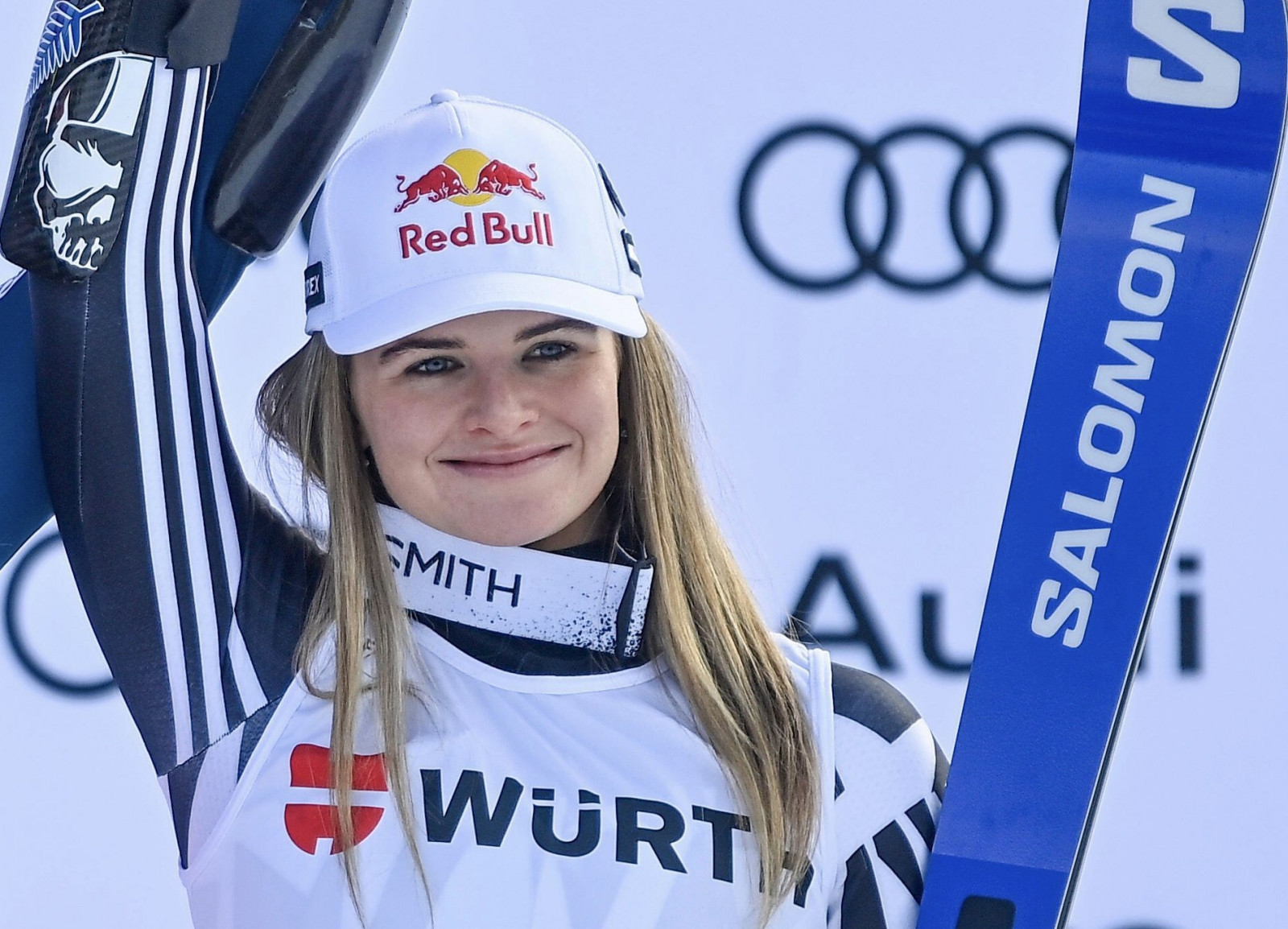
Copper Mountain offered a simple but decisive reminder: when women’s giant slalom catches fire, it tells a story that goes far beyond a single result sheet. On Saturday, that story carried a clear name. Alice Robinson didn’t just win — she imposed herself. Two winning runs, unbroken commitment on her edges, a line that never drifted: the New Zealander delivered a performance that weighs more than an early-season victory.
The opening run had already set the tone: Robinson was above the field — more direct, more stable, more assertive through the transitions. The second run simply confirmed what the first had suggested: she now combines the raw power that made her burst onto the circuit with a much sharper sense of control. At Copper, she skied as if every gate had something to prove. By the finish, nothing was left in doubt.
Two runs, two fastest times, no visible hesitation. Copper Mountain marks the return of a more complete Alice Robinson: still explosive, but now capable of managing an entire race without a single tactical compromise.
Women’s giant slalom may not yet have a new long-term queen — but it knows exactly who has opened the season’s debate.
A podium that doesn’t follow the old script
Behind Robinson, the podium itself felt like a change of era. Julia Scheib delivered a second run of genuine authority — precise, patient, and calm where the course required it least. Her progression over the past year is beginning to show in results: Austria has not simply found a one-day surprise, but a skier who looks increasingly at home near the front.
Thea Louise Stjernesund completed the top three with a strong charge, built on a perfectly measured attack in the steepest part of the course. For months, she has been quietly accumulating solid results; Copper pushes her one step further, from solid presence to fully fledged podium contender.
Switzerland moves up, Ljutic expands, Colturi and Shiffrin search for the right tone
For Switzerland, Camille Rast confirmed exactly what the team needed: progression and reliability. She climbed five places with a clean, disciplined second run — not spectacular, but efficient in all the right areas. In a winter without Gut-Behrami in the globe race, this kind of stability matters.
Zrinka Ljutic, meanwhile, keeps stretching the limits of her skiing. Seventh at the end of the day, with a composed and energetic second run, she continues to move from “pure slalom specialist” toward a profile that can matter in both technical events. The signs were there last season; Copper turns them into something more concrete.
For Lara Colturi and Mikaela Shiffrin, the outcome was more nuanced. Colturi’s skiing remained solid but lacked a touch of reach in the second run — good enough for points and rhythm, not yet sharp enough for the sharp end of the classification. Shiffrin, as often in recent years, never quite found the same ease in giant slalom that she shows almost by nature in slalom. Nothing alarming for either, but Copper does underline the level now required to stay in the conversation.
The emergence: Scheib and Stjernesund step firmly into regular podium contention.
The confirmation: Rast anchors a more ambitious Swiss GS team.
The pressure: Colturi and Shiffrin will need a stronger answer in the next giants.
The threat: Ljutic can no longer be described as “only” a slalom skier.
A giant slalom suddenly wide open
The temporary absence of Lara Gut-Behrami and Federica Brignone from the globe race had already opened a door. Copper quietly pushes it wider. The podium brings together three different nations, three different styles, three different ways of reading the hill. Behind them, the pack is dense and competitive, ready to occupy the space left by the two great names who have stepped aside.
The first North American stop leaves a clear impression: this may be one of the most fluid disciplines of the winter. Dominating occasionally will not be enough; surviving consistently might make the difference.
Next up: slalom — and a real three-way duel
Sunday belongs to slalom, and the tension is not the same as a year ago. Mikaela Shiffrin still carries the natural authority of the discipline, but she no longer skis with the margin she avait once enjoyed. Lara Colturi moves with the confidence of a skier who knows she can win anywhere, yet still needs to secure continuity. Zrinka Ljutic, finally, is building something different: a bold, offensive ski that seems to grow with every race.
The sorting will continue. And here too, Copper Mountain may do more than distribue points: it may quietly redraw the balance of the winter.