
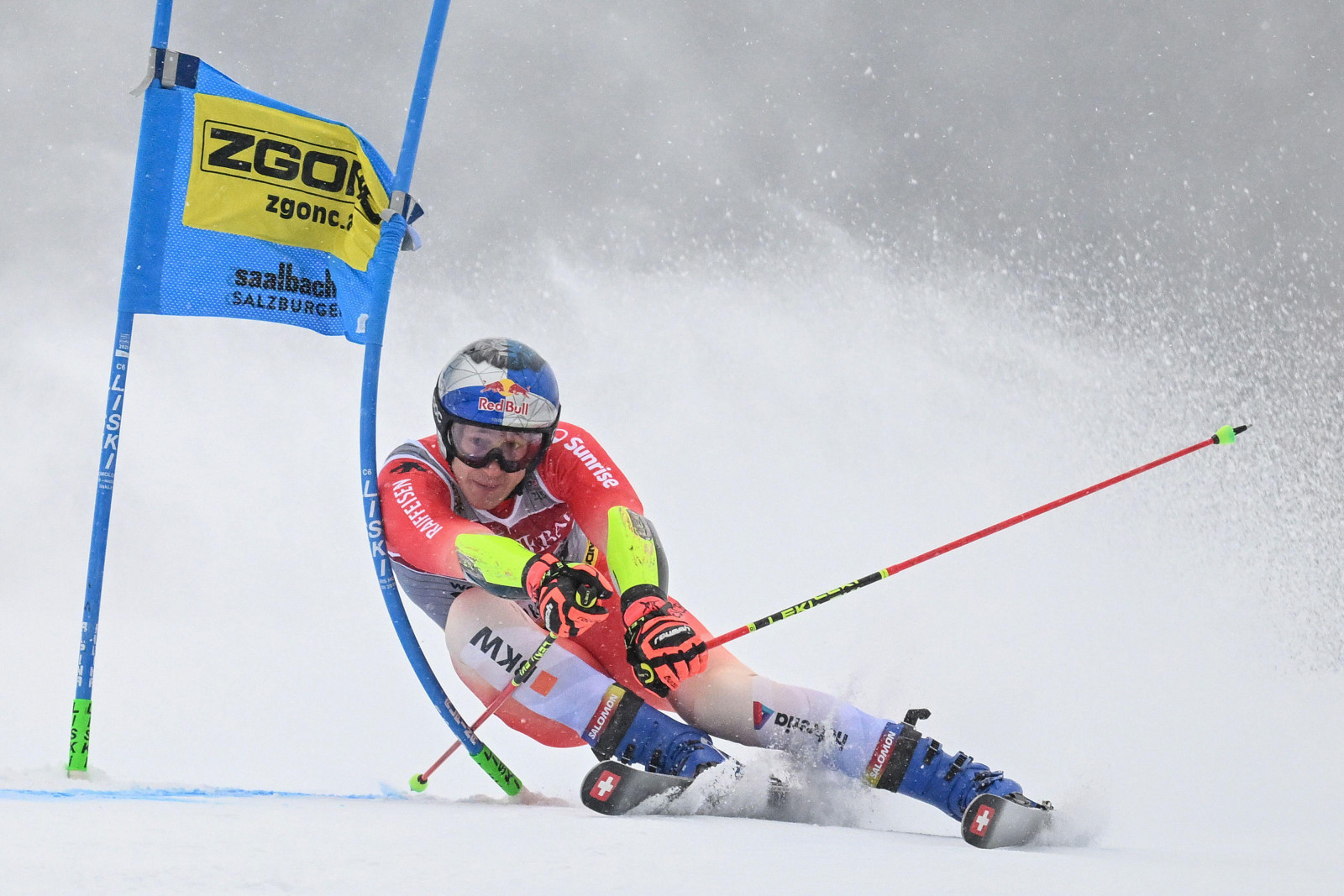
Copper Mountain was meant to open the North American stretch; instead, it served as an early reminder of what an Olympic winter really looks like. In two days, the men’s Super-G and giant slalom revealed the same pattern with different outcomes: Marco Odermatt’s authority in speed, a long-awaited breakthrough for Stefan Brennsteiner, a revived Henrik Kristoffersen — and the sense that this season’s hierarchy will not settle quietly.
Super-G — Odermatt sets the tone
The first speed race of the Olympic year delivered a familiar headline: Marco Odermatt, in control from the opening meter. The Swiss star took the win in 1:07.70, eight hundredths ahead of Vincent Kriechmayr and thirteen ahead of Raphael Haaser. A clean, composed, nearly clinical run — the kind that has made him the sport’s fixed point.
Copper, long used primarily as an early-season training base, offered exactly the environment where Odermatt thrives: dry snow, hard surfaces, high altitude, little room for hesitation. Two races into the winter, two victories — and an early lead in both the Super-G standings and the overall race.
1. Marco Odermatt (SUI) — 1:07.70
2. Vincent Kriechmayr (AUT) — +0.08
3. Raphael Haaser (AUT) — +0.13
4. Stefan Babinsky (AUT) — +0.39
5. Fredrik Møller (NOR) — +0.41
6. Lukas Feurstein (AUT) — +0.45
7. Stefan Rogentin (SUI) — +0.58
8. Guglielmo Bosca (ITA) — +0.61
9. Franjo von Allmen (SUI) — +0.75
10. Ryan Cochran-Siegle (USA) — +0.83
The Austrian block was the day’s other headline: Kriechmayr, Haaser, Babinsky, Feurstein and Hemetsberger all in the top 15 — a level of density that always matters when the North American swing begins. Italy remained steady rather than spectacular, while Norway lived a symbolic moment with Aleksander Aamodt Kilde returning to World Cup speed for the first time since his crash in Wengen. His 24th place is not a result yet — but it is a step.
For the U.S. team, the home race offered encouraging signs: Cochran-Siegle in the top 10; Radamus and Negomir solidly in the points. France’s young group placed Alban Elezi Cannaferina 18th, one of the day’s quiet successes.
Giant Slalom — Brennsteiner’s late bloom, Kristoffersen resurfaces
Twenty-four hours later, the story shifted. The giant slalom went to a man who knows patience better than anyone in the field: Stefan Brennsteiner, 34, earning the first World Cup victory of his career. Fastest in the opening run, composed in the second, he held a comfortable margin to cap an emotional day for the Austrian camp.
Behind him, Henrik Kristoffersen delivered the performance he had been missing for months: clean skiing, pace in the flats, and technical clarity. His second place — his first GS podium of the season — reopens a battle that some feared was already tilting entirely toward Odermatt.
1. Stefan Brennsteiner (AUT) — 2:30.98
2. Henrik Kristoffersen (NOR) — +0.95
3. Filip Zubčić (CRO) — +1.00 (13 → 3)
4. Marco Schwarz (AUT) — 2:32.00
5. Alex Vinatzer (ITA) — +1.16
7. Léo Anguenot (FRA) — +1.34 (career best)
DNF1. Marco Odermatt (SUI), Timon Haugan (NOR), several top names out early.
The shock was Odermatt’s exit in the first run — a rare, costly mistake on a surface where tiny imperfections become decisive. It stops a remarkable GS consistency streak and places Brennsteiner in the red bib with 150 points, ahead of Schwarz, Kristoffersen and Odermatt.
North American focus
For U.S. and Canadian fans, Copper offered a realistic picture: progress on home snow, but no breakthrough yet. Cochran-Siegle’s 10th place in Super-G was the best North American result of the block. River Radamus (22nd SG, 11th GS) remains consistent; Canada’s James Crawford and Jeffrey Read stayed within range but not in contention.
In an Olympic year, such early benchmarks matter. Copper did not settle the season — but it drew its first lines clearly enough.
What Copper really means
Odermatt leaves Colorado as the overall leader and the unquestioned benchmark. But the discipline narratives are still open. Kristoffersen is back in the GS conversation. Brennsteiner adds an unexpected variable. Austria leaves with structure; Norway with depth; Italy with stability; the U.S. with potential but not yet results.
The North American swing now moves to Beaver Creek — and with two races already in the books, the Olympic winter has finally begun to take shape.