
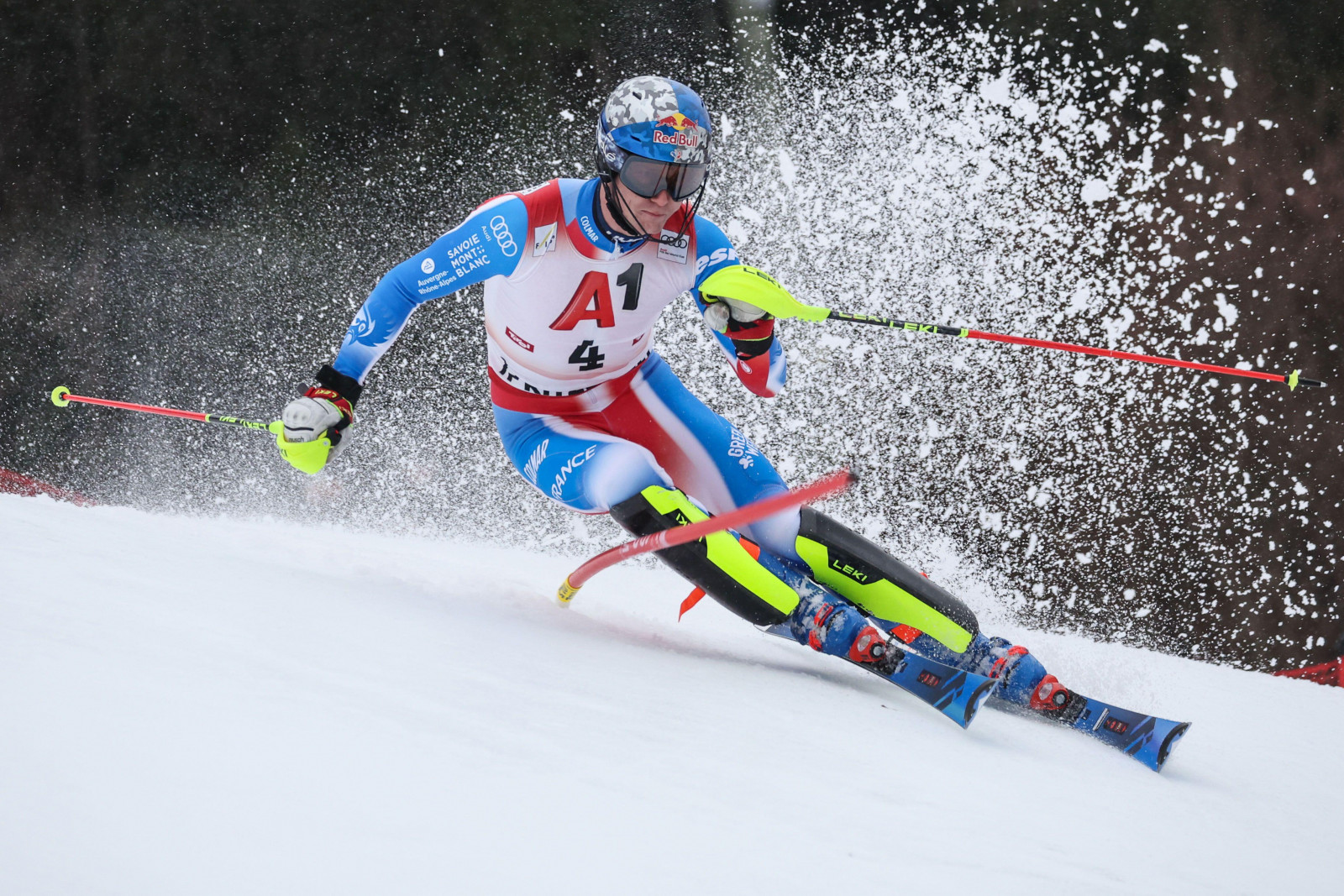
Gurgl delivered something entirely different from Levi. Same early-season slalom, same field, same stakes — but a completely changed hierarchy. The slope hardened, the sun cut through the surface, and the race turned into a two-run minefield that rewarded courage rather than control. Out of this volatility came one clear headline: France took over the day, and Paco Rassat wrote a chapter nobody had scripted.
Rassat, the improbable winner
Starting the second run in 21st position, Rassat produced the fastest final run of the day — a sharp, committed descent that erased a full second of deficit and left him seven hundredths clear at the finish. It was not a victory built on control, but on momentum: a skier who understood that the slope was deteriorating and that hesitation was no longer an option. At 27, he becomes the 17th Frenchman to win a men's World Cup slalom, and the new red bib of the discipline.
Bourgeat launched the modern era (2001). Vidal confirmed the revival (2006). Grange and Lizeroux shaped a golden window (2008–2011). Pinturault extended the line (2013–2020). Noël dominated the last Olympic cycle (2019–2025). Rassat adds his name in 2026.
Behind him, Armand Marchant delivered a run of similar audacity. From 13th to 2nd, the Belgian clinched the first World Cup podium in his country’s history. It was not just a result: it was a confirmation of a technical program that has been progressing quietly for years, and finally broke through on a day where precision mattered more than power.
Atle Lie McGrath, clean and uncompromising in the first run, completed the podium — a rebound after the frustration of Levi and a reminder that Norway, in this discipline, has depth even when its leader is searching for answers.
Norway: depth without domination
Norway no longer has a singular reference in slalom. But it has variety — and resilience. McGrath returns to the podium after a DNF in Finland. Timon Haugan confirms his early-season consistency with a fourth place. Sandvik, still young, builds in small steps but with undeniable clarity.
Kristoffersen remains a puzzle: two races, two finishes, no podium, and a ski that does not hold with the assurance it once had.
France: one victory, but above all a collective
Gurgl offered France more than a winner. It revealed a team stepping into its structure. Rassat wins. Muffat-Jeandet places seventh, solid and precise. Noël finishes 12th ex aequo — irregular again, but present when the slope turns hostile. Amiez slips to 15th. Over two weekends, the French group shows density, stamina, and the ability to place several skiers in the right zone even without a perfect day.
1. Rassat — 1:44.55
7. Muffat-Jeandet — 1:45.28
12. (ex aequo) Noël — 1:45.54
15. Amiez — 1:45.64
After Levi: 2nd (Noël), 6th (Rassat), 8th (Amiez).
Other nations: questions rather than confirmations
Austria. Six men in the points, but none on the podium at home. Raschner climbs from 28th to 6th, the performance of the day behind the leaders. Feller blows up in the second run. Schwarz remains far. The structure is intact, but the precision is not.
Switzerland. Nef delivers one of the performances of the weekend with a fifth place — and earns his Olympic selection. But behind him, Meillard, Rochat and Aerni all exit. The Swiss team still lacks stability.
Italy. Vinatzer progresses, Kastlunger disappears. A fragile picture.
United States. No qualifier for run two — a brutal contrast after promising work in Levi.
Finland. Hallberg, third in Levi, is out in the second run. Promise in Lapland, no regularity yet.
A slope, a sun, and the chaos between the two
The Kirchenkar slope offered a paradox. After heavy snowfall, race day opened under clear skies. The surface, solid during inspection, transformed under the sun: the ice reappeared, sharp and unpredictable. Skiers who trusted the first impression paid the price. Those who adapted — Rassat, Marchant, Raschner — found the solution.
Seven skiers starting outside the top 30 qualified for the final. A rare statistic in men’s slalom — and a sign of a winter that refuses to settle.
A slalom season without a centre of gravity
Two races, two different stories. Levi had its outsiders, Gurgl its climbers. Braathen wins once, Rassat wins once. The veterans search, the younger men strike in bursts. Nothing resembles a hierarchy — not yet.
The only certainty is that this Olympic season will not tolerate hesitation: every run is a filter, every mistake costs twice, every slope can overturn the script.
Next stop: Val d’Isère, on December 14. Rassat will wear the red bib. And the men’s slalom, still without an owner, will take another step toward defining its winter.