
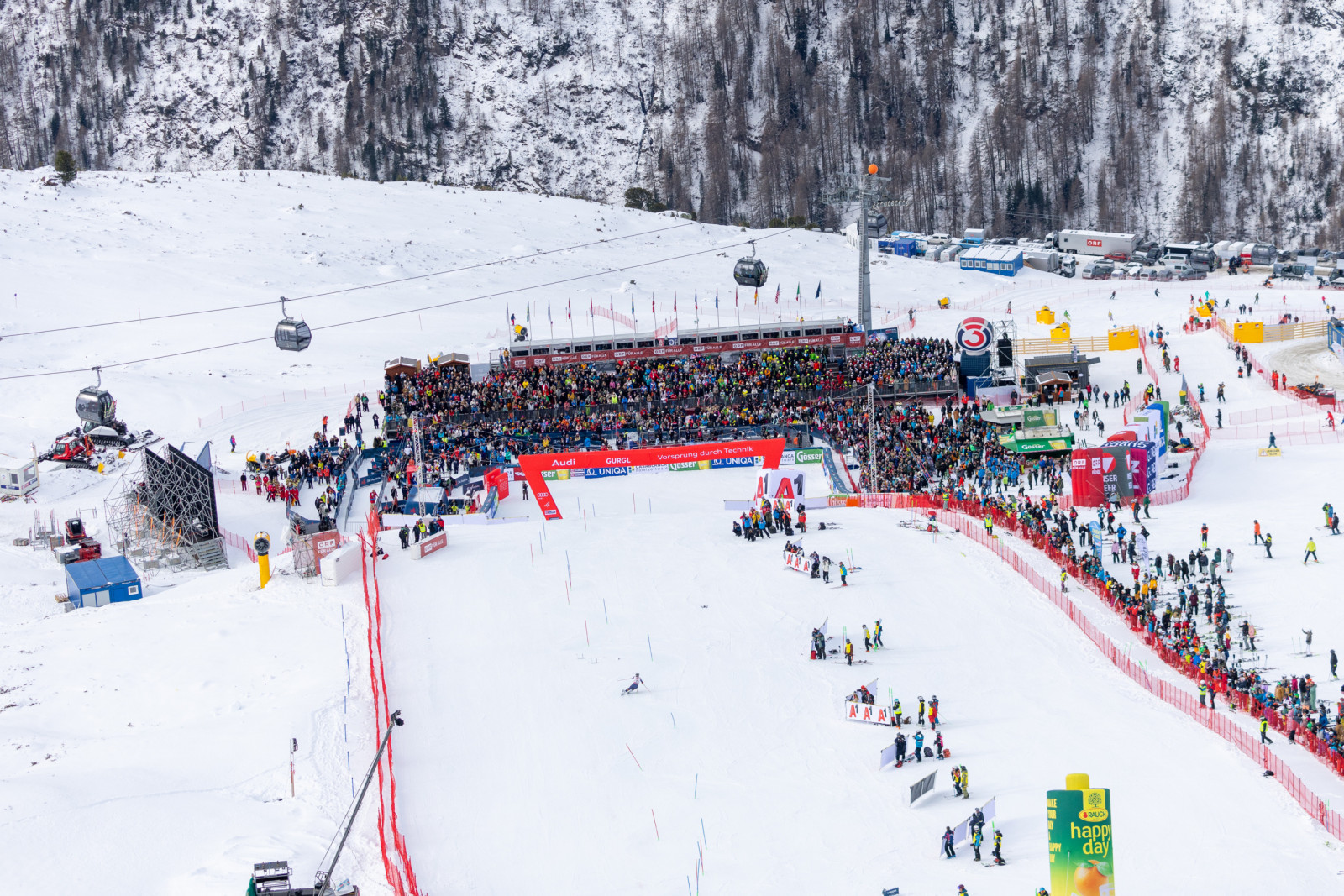
After Levi’s polar opener — Brazilian breakthrough, French confirmation, Finnish awakening — the World Cup drops into something much more elemental: Gurgl, its Kirchenkar slope and the steep wall suspended above the Top Mountain Crosspoint. No mythology here, no century-old rituals. Just a compact glacial bowl, steep, perfectly prepared, and built for two uncompromising runs.
It took only two editions to understand what this place is: Gurgl belongs to no nation. It reveals more than it rewards.
Location: Hochgurgl (Ötztal, AUT)
Name: “Kirchenkar” = the church’s cirque
Elevation: 2,475 m start – 2,265 m finish
Vertical drop: 210 m
Homologation: 15061/10/23
Gates: approx. 65 per run (2024 reference)
Typical snow: very hard, prepped for two full runs; positive temps possible in the finish area.
Three winters, three stories
The inaugural 2023 edition looked like a national statement: Feller–Schwarz–Matt, hard snow, sharp set, mini–Nightrace atmosphere. Austria’s race, Austria’s hill.
Then came 2024:
- 1. Clément Noël (FRA) – 1:46.25
- 2. Kristoffer Jakobsen (SWE) – +0.43
- 3. Atle Lie McGrath (NOR) – +0.44
Not a single Austrian on the podium, only one in the top ten. The Kirchenkar suddenly looked neutral — demanding, precise, indifferent to the passport.
So 2025 arrives with a fully known slope — same homologation, same drop, same altitude — but still with no natural owner.
Lucas Pinheiro Braathen — from Björn to the Kirchenkar
Levi gave Braathen the scene of his life: first career win, first Brazilian victory, and a reindeer named “Björn” after his father. A perfect northern opener.
Gurgl is the opposite: steep, narrow, minimal transitions, hard snow that stays firm to the line, and a set that often becomes aggressive right from the first gate.
He was fourth here in 2024, just over a second off Noël. This time, he comes as the man to beat — and with the obligation to turn Levi’s emotion into Austrian precision. A win here would mark a shift: from a moment to a narrative.
Clément Noël — Gurgl as a field of expression
Noël was 12th in 2023 on a slope nobody knew. A year later, he owned it: clean first run, sharper second, clear victory over Jakobsen and McGrath.
Gurgl suits him: direct pitch, early engagement, drift control without losing the line. The sets reward exactly what he does best.
After a strong podium in Levi, Gurgl offers him something simple and essential: continuity. If he wins again here, the Olympic season won’t look like a comeback — but like a straight line.
Blocks in motion — Switzerland, Norway, Nordics, Austria
Switzerland. Meillard fifth last year, Nef consistently near the top, Yule always lurking. A “technical-dry” hill, perfect for Swiss precision.
Norway. McGrath 3rd, Kristoffersen 6th, Haugan 9th in 2024 — strong, but not dominant. Levi demands a collective rebound, especially with Braathen in the spotlight.
Sweden & Finland. Jakobsen’s 2nd place confirmed his affinity for compact slopes with progressive intensity. Hallberg (8th in 2024) has everything to gain from another top five run outside home snow.
Austria. After the 2023 sweep, the loss in 2024 still stings. Expectations are high — but Gurgl has already shown it won’t bend to sentiment.
2023: 1. Feller (AUT), 2. Schwarz (AUT), 3. Matt (AUT) — Austrian sweep; Noël 12th.
2024: 1. Noël (FRA), 2. Jakobsen (SWE), 3. McGrath (NOR); Hallberg 8th, Gstrein 10th.
What Gurgl will really say
If Braathen confirms Levi, the slalom may have found its new face. If Noël wins again, Gurgl becomes his territory — and a clear marker for the Olympic winter. If Switzerland, Norway or the Nordics take over, the season will read more like density than domination.
The Kirchenkar has no folklore, no mythology. But across two runs and 210 meters of fall-line, it already states one truth: here, you don’t live on reputation. You stay by holding the line.
F.R. ARP