
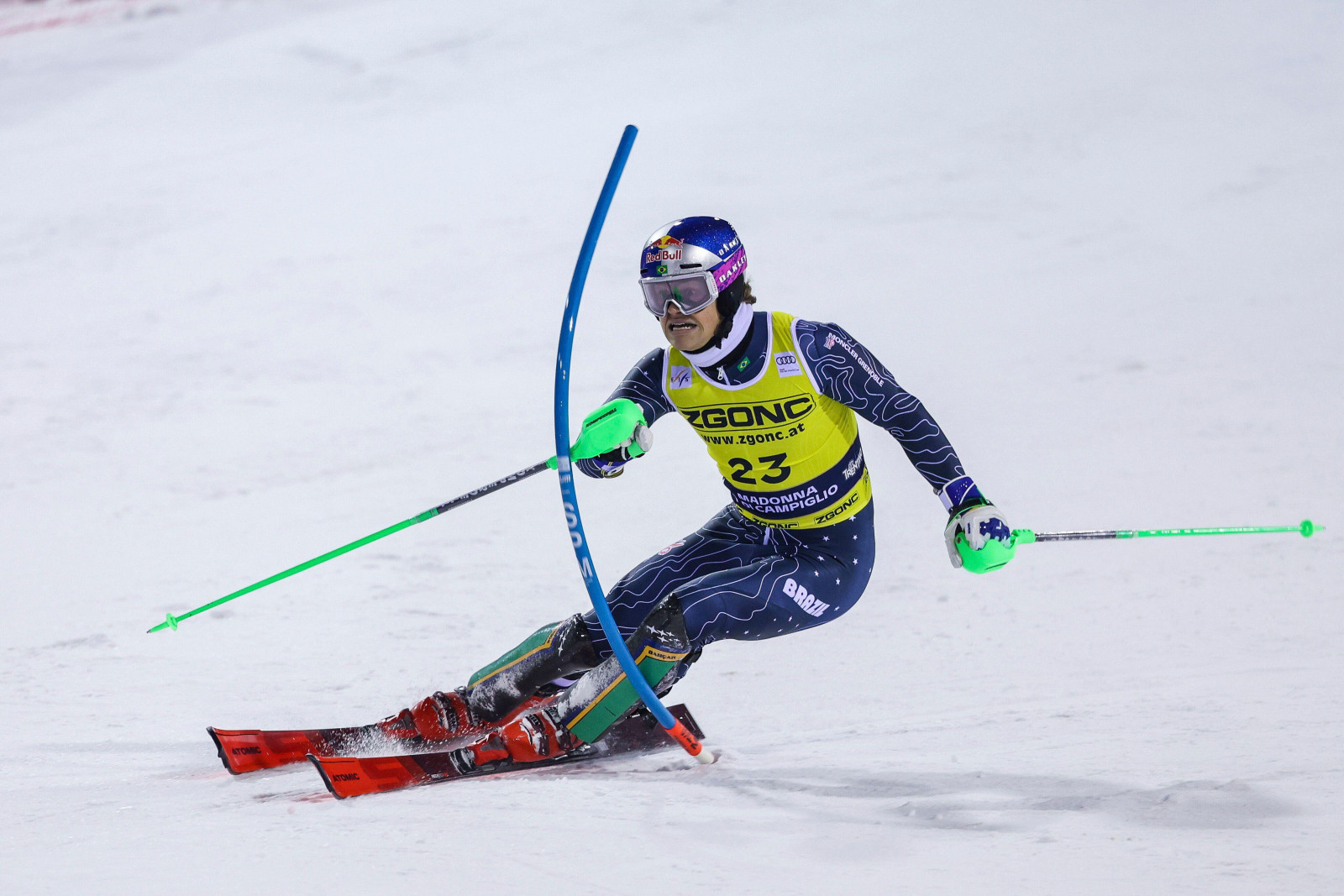
LEVI, Finland — Sunday, November 16, 2025 — Once again this weekend, under the floodlights of Levi Black, the men's slalom delivered one of the season's most improbable races. Lucas Pinheiro Braathen (BRA), the ex-Norwegian turned Brazilian, won and gave Brazil its first historic victory in alpine skiing World Cup. Clément Noël (FRA), defending champion in Levi, finished second, 0.31 seconds back. But the real thunderbolt came from Finland: Eduard Hallberg, 22, claimed bronze at home and became the first Finnish slalom podium finisher since Kalle Palander. Henrik Kristoffersen (NOR), holder of the slalom globe, collapsed to thirteenth place. Loïc Meillard (SUI), world champion, finished fourteenth. An arctic night of upheaval that opens the chase toward the Milano Cortina 2026 Olympics under the sign of audacity and the unpredictable.
First Run: Braathen Dominates, Hallberg Breaks Through
From the first run, Lucas Pinheiro Braathen set the tone. Starting with bib 4, the Brazilian delivered a flawless descent: fluid on the flat, explosive on the pitch, impeccable through the transitions. Reference time: 54.13. "I had a plan and a strategy, and I followed them. I know that when I follow my plan, I have a lot of potential," he would say after the race.
Behind him, Clément Noël handled the entry banana unevenly but posted a solid lower section to land in second place (+0.41). The Frenchman, defending champion in Levi, was in the fight. Timon Haugan (NOR), third provisionally (+0.49), confirmed his brilliant early-season form. Linus Strasser (GER), bronze medalist in Saalbach, slid into fourth (+0.85) with his characteristic consistency.
And then came Eduard Hallberg. Bib 29. Finnish. Twenty-two years old. In front of his home crowd. The roar began at the first split: Hallberg was fast. Very fast. He attacked the pitch with an audacity that electrified the crowd. At the finish, fifth-best provisional time: 55.03, just 0.90 seconds behind Braathen. Levi Black exploded. Finnish flags waved in the arctic night. The dream was alive.
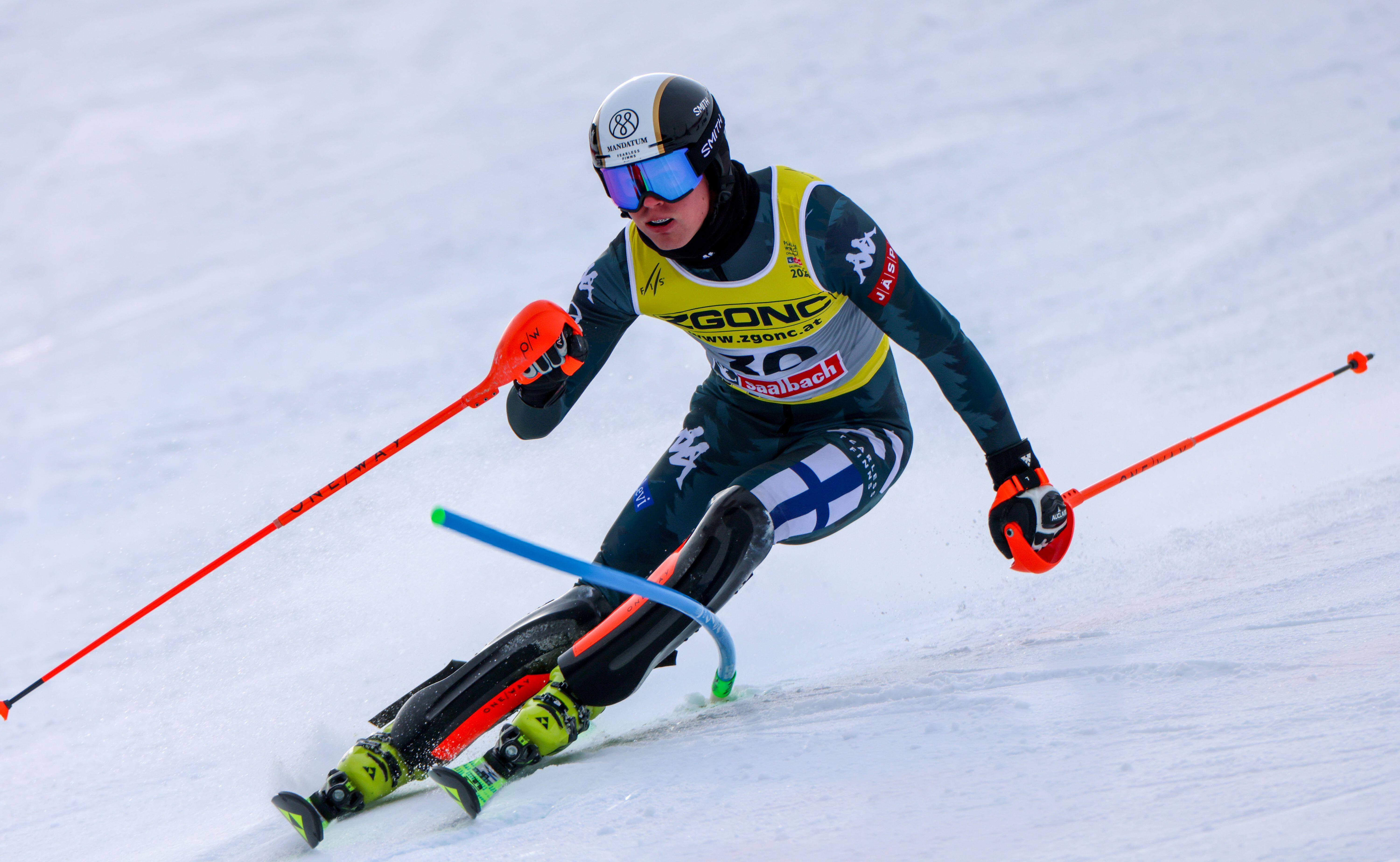
Fabio Gstrein (AUT), seventh provisionally, and Steven Amiez (FRA), eighth, also qualified for the final. But the shocks came from the big names missing from the top 10. Loïc Meillard (SUI), world champion, couldn't find his marks and finished tenth in the first run (+1.32). Worse still: Henrik Kristoffersen (NOR), holder of the slalom globe, made several technical errors and pointed ninth (+1.23). The Levi puzzle persisted for Meillard. The Norwegian boss was wobbling.
After the first run, one thing was clear: anything was possible. Braathen was the favorite, Noël could come back, Haugan was lurking. But it was Eduard Hallberg who drew all eyes. Could he hold on? Could he give Finland its first slalom podium in sixteen years? The answer would come under the floodlights of the final.
Second Run: Hallberg Holds, Braathen Triumphs, Favorites Collapse
The second run promised high tension. The thirty qualifiers launched on a treacherous course where ruts deepened with each passage. And from the first descents, the unexpected struck.
Laurie Taylor (GBR), fifteenth after the first run, delivered a phenomenal run. The 29-year-old Brit attacked every gate with fierce determination and posted the run's best time: 55.73. He jumped to provisional first place, ahead of all the favorites. The crowd was stunned. Taylor, formerly 34th in the world, had just skied the race of his life.
But the real question remained: could Eduard Hallberg hold on? Starting fifth, the Finn launched under his crowd's roar. First section: clean. Pitch: committed. Transitions: fluid. At the finish, sixth-best time of the run (56.26), enough to provisionally take the lead with four hundredths over Taylor. Levi Black went wild. Eduard Hallberg, Olympic bronze within reach—would he savor his podium?

The heavy hitters launched. And the disappointments piled up. Henrik Kristoffersen, Norwegian globe winner, made a mistake in the upper part of the course and finished with a catastrophic time. Thirteenth overall (+1.47), the slalom world's boss collapsed. Loïc Meillard, world champion, did little better: fourteenth (+1.48). Atle Lie McGrath (NOR), World Championship silver medalist, crashed out in the second run.
Three of the top five in the world rankings faltered. A massacre. Levi, short and nervous course, forgives nothing. Not hesitation, not technical error, not mental doubt. Tonight, only the bold survived.
Timon Haugan, third after the first run, also made a mistake at the top and dropped to fifth place (+0.77). Paco Rassat (FRA), thirteenth at halfway, delivered a fine climb to finish sixth (+1.04). Steven Amiez (FRA) held on for eighth (+1.26). The French delivered.
Clément Noël remained. The Frenchman, 2022 Olympic champion, started in second position. Clean, precise, constant. He lit up green everywhere and passed Hallberg by twenty-six hundredths. Second place secured. The Finnish podium still held. But so did the Brazilian victory.
Because Lucas Pinheiro Braathen, last to start, didn't tremble. Fluid skiing, well-placed line, perfect mental management. He won with a 0.31-second margin over Noël and claimed a historic victory: Brazil's first in alpine skiing World Cup. "There's a lot of pride in that," he would say, visibly moved. In September, he told the Associated Press: "The victory will come, and it will come soon." Promise kept.
Hallberg: The Finnish Dream Made Real
Eduard Hallberg didn't believe it himself. Fifth after the first run, less than a second from Braathen, the Finn knew a podium was possible. But between possible and real lies an abyss. An abyss he crossed under the roar of Levi Black.
"Best time for Hallberg!!!" roared the Eurosport commentator as the Finn passed the first splits in the second run. "Exceptional! He's on fire on his course!" The crowd couldn't believe their eyes. Eduard, the discreet one, the patient one, the pianist of the Austrian method, suddenly played fortissimo.
Sixth-best time of the run (56.26), enough to keep his third place and claim Finland's first slalom podium in sixteen years. Kalle Palander, the last Finn on a slalom podium in World Cup, retired in 2009. Since then, desert. Until today.
Hallberg embodies the rebirth of Finnish slalom. Trained under Austrian coach Mario Rafetzeder—Finland imported alpine expertise—he applies the method called "piano ma non troppo": patience at season's start, gradual crescendo, explosion at the right moment. In Saalbach last February, he finished twelfth at the World Championships, Finland's best result since Palander. In Levi, in front of his crowd, he confirms he's no fluke. He's the future.
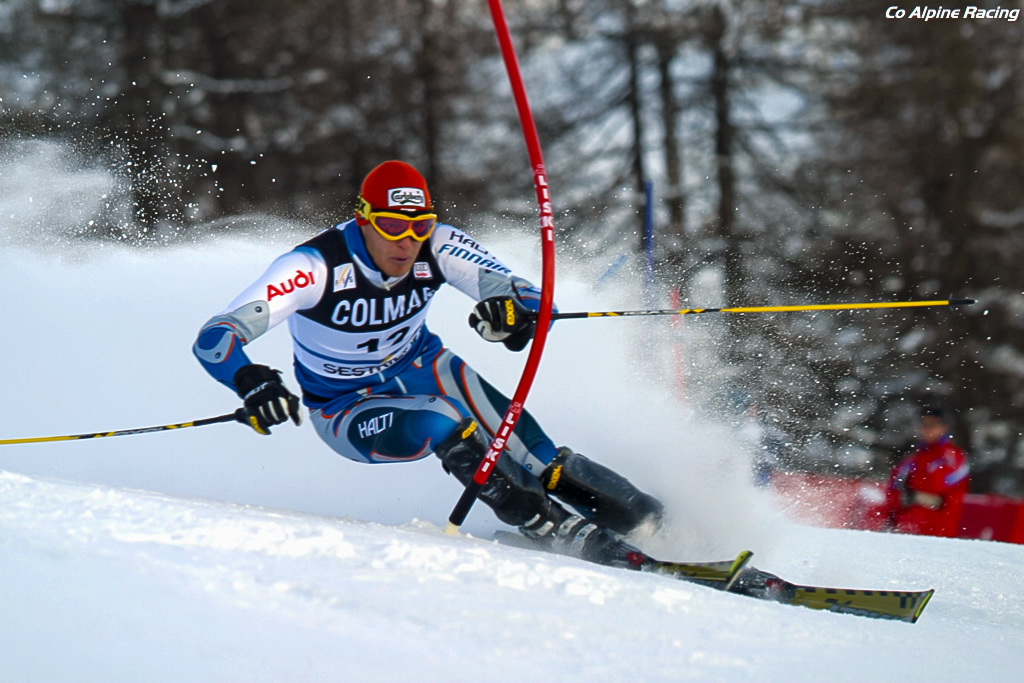
"It's crazy," he would say after the race, voice trembling. "I knew I could ski well here, but a podium... I didn't dare believe it. Now it's done. For me, for Finland, for everyone who supported me."
Finland has no mountains. No Alps, no alpine tradition comparable to Austria or Switzerland. But it has ice, snow, tenacity. And now it has Eduard Hallberg, third in Levi slalom, hero of a nation that refuses to believe geography dictates destiny.
Five Finns started today. Four didn't make it past the first run. Jesper Pohjolainen, Rosa Pohjolainen's brother (28th in women's yesterday), tried to apply the score to the letter. But in Levi, under the pressure of a first home World Cup, the crescendo didn't come. Thirty-first after the first run (56.40), six tenths from qualification. Rosa had found the necessary acceleration to finish on Saturday. Jesper stayed too long piano. Too long restrained. At the end of the course, the acceleration was missing. Six tenths. The difference between qualification and disappointment.
Jesper is still in adagio: relaxed, calm, sixty beats per minute. Rosa found her andante on Saturday. Eduard played allegro today. The Finnish symphony is being written, movement by movement.
But tonight, it's Eduard who carries Finnish hope. And he carries it all the way to the podium. Milano Cortina 2026? In three months, the Finn will be there. With, from now on, the confidence of an athlete who knows he can beat the best. When it counts. In front of his crowd. Under the arctic stars.
Braathen: The Brazilian Prophecy
Lucas Pinheiro Braathen had predicted everything. In September, in an interview with the Associated Press, he prophesied: "The victory will come, and it will come soon." Three months later, under the floodlights of Levi Black, the Brazilian by adoption kept his word. And what a word.
Born in Norway, trained in Norway, slalom globe 2022-2023 under Norwegian colors, Lucas Pinheiro Braathen won everything with the Scandinavian nation. Five World Cup victories, podiums in succession, a reputation as explosive capable of the best and the worst. Then the break. A conflict with the Norwegian federation over his personal marketing rights. Lucas wanted to keep control of his image. The federation refused. He left the national team. Took a sabbatical year. Disappeared from radar.
And came back in 2024 under Brazilian colors, his mother's country. First Brazilian in World Cup since 2016, he chained five podiums during his first season. But no victory. Close several times, never at the summit. "It will come," he repeated. "I know that when I follow my plan, I have a lot of potential."

This Sunday, the plan was perfect. First run: 54.13, best time, 0.41 seconds ahead of Noël. Attack on the flat, explosiveness on the pitch, fluidity in transitions. Braathen left nothing to chance. "I had a good feeling. I had a plan and a strategy, and I followed them," he would explain.
In the second run, the pressure mounted. He was last to start. Noël had just taken provisional lead. Hallberg held his Finnish podium. But Braathen didn't falter. Fluid skiing, well-placed line, flawless mental management. At the finish, 56.59, enough to keep first place. Victory: 1:50.72, with a 0.31-second margin over the Frenchman.
Brazil, nation of football and samba, has just won its first victory in alpine skiing World Cup. Never an Olympic medal, never a world medal, never a WC victory. Until Lucas Pinheiro Braathen. Until Levi. Until today.
"There's a lot of pride in that," he would say, visibly moved. "Wearing Brazil's colors is special for me. My mother is Brazilian, it's my country too. This victory is for Brazil, for my family, for everyone who believed in me."
At twenty-five years old, Lucas Pinheiro Braathen enters history. Not just Brazilian skiing history—which begins today—but also world slalom history. Because his trajectory poses an essential question: can you change nations, take a sabbatical year, come back to the top and triumph? Lucas just answered: yes. With style. With audacity. With a plan. And a lot of potential.
Noël: The Champion Confirms
Clément Noël didn't win. But Clément Noël never really loses. Defending champion in Levi after his crushing victory in November 2024 (+0.80 seconds over Kristoffersen), the Frenchman finished second today. Podium secured, title defended with style, season opened on the right foot.
In the first run, Noël handled the entry banana unevenly—that flat section opening Levi Black's course—but posted a solid lower section to point second provisionally (+0.41). The 2022 Olympic champion was in the fight. Not in front, but never far. That's his style. Explosive, sometimes fragile, always capable of coming back.
In the second run, the race became a thriller. Laurie Taylor (GBR) blew up the time. Eduard Hallberg held his Finnish podium. Kristoffersen and Meillard collapsed. Noël didn't falter. Starting in second position, he delivered a clean, precise, constant run. Tenth-best time of the run (56.49), but enough to pass Hallberg by twenty-six hundredths and secure second place. At the finish, 1:51.03, just 0.31 seconds from Braathen. Podium guaranteed. Mission accomplished.
"It's a nice second place," he would say in the mixed zone. "Lucas was very strong today. I knew it would be difficult to catch him. But I'm happy with my skiing. Clean, committed, no mistakes. That's exactly what needed to be done."
Noël embodies modern slalom's paradox. Over the last three seasons, he shows the circuit's best average rank: 4.36. Better than Kristoffersen (5.20), better than Meillard (5.79). The Frenchman, when he finishes, finishes in front. The problem? He only finishes three out of four races. Three-year finish ratio: 66.7%. He's improving though: 75% in 2025 (9 races finished out of 12).
Clément Noël is podium or DNF. Rarely in between. But when he stays upright, he's formidable. Today, he held. And that's enough for an arctic podium that opens his Olympic season on the right foot.
With Paco Rassat (6th) and Steven Amiez (8th), France placed three skiers in the top 10. A solid French performance that bodes well for the rest of the season. Victor Muffat-Jeandet, twentieth, also qualified for the final. The Blues are there. Noël at the front, as often. Not always first, but always in the fight.
The Favorites' Collapse: Kristoffersen and Meillard Sink
Henrik Kristoffersen was the announced favorite. Holder of the slalom globe, double winner in Levi (2018, 2024), impressive 92.3% finish ratio last season. The thirty-one-year-old Norwegian was supposed to open his Olympic season as boss. He finished thirteenth. A disaster.
Ninth after the first run (+1.23), already in difficulty, Kristoffersen made a technical error in the upper part of the course in the second run. Catastrophic time: 56.83, seventeenth time in the final. He dropped to thirteenth place (+1.47), far, very far from the podium. For a skier who never finishes outside the top 5 when he finishes, it's humiliation. A warning too.
"There were mistakes," he would acknowledge laconically in the mixed zone. No excuses, no justifications. Just the bitter observation of a day to forget. After his thirteenth place at the World Championships in Saalbach last February, this new failure raises questions: can Kristoffersen still win big events? Milano Cortina 2026 is approaching. Time is running out.
Loïc Meillard, world champion in Saalbach, did little better. Tenth after the first run (+1.32), the Swiss hoped to restart in the final. But Levi, short and nervous course, simply doesn't suit him. Average time in the second run (56.75), fourteenth final rank (+1.48). In six participations in Levi, Meillard has never done better than third place (2024). This year, strong from his world title, he arrived with other ambitions. Result: another arctic disappointment.
"I can't find my marks here," he would admit. "It's too short, too nervous. I can't express my fluidity. It's frustrating, but that's how it is. We have to move on."
The favorites' collapse didn't stop there. Atle Lie McGrath (NOR), World Championship silver medalist, crashed out in the second run. Timon Haugan (NOR), three victories this season, made a costly error and dropped to fifth. Linus Strasser (GER), Saalbach bronze, collapsed from fourth to fifteenth place.
Levi, demanding, technical, treacherous course, forgives nothing. Not hesitation, not error, not doubt. Tonight, only the bold survived. Braathen, Noël, Hallberg: three skiers who took all the risks. And won everything. The others, favorites on paper, went home empty-handed. Or almost.
The British Surprises: Taylor and Ryding
Laurie Taylor (GBR) wasn't expected. Fifteenth after the first run, 1.47 seconds from Braathen, the 29-year-old Brit seemed doomed to an anonymous placement in the top 15. Then the second run changed everything.
Taylor launched with bib 32. The course was still fresh, the ruts less deep. He attacked every gate with fierce determination, chained turns with perfect fluidity, and crossed the finish line with the run's best time: 55.73. Astonishment. The Brit took provisional lead, ahead of all favorites. And stayed there for a long time.
At the finish, fourth final place (+0.61), just four hundredths from the podium. Passed at the last moment by Eduard Hallberg, Taylor nevertheless delivered the race of his life. Career-best result, run's best time, crowd ovations. "I still can't believe it," he would say with shining eyes. "I just attacked, took all the risks, and it paid off."
Dave Ryding (GBR), thirty-nine years old, circuit veteran, completed the fine British day. Eleventh after the first run, he maintained seventh overall (+1.16). For British alpine skiing, a nation without major alpine tradition, placing two skiers in the top 10 of a World Cup slalom is a rare feat.
"We proved we can compete with the best," Ryding summarized. "Laurie was exceptional today. I did my job. Together, we showed that British skiing exists. And that it counts."
Taylor and Ryding, like Hallberg for Finland, embody the victory of nations without mountains. Countries where alpine skiing isn't a geographic given, but a choice. A bet. An obstinacy. Today, that bet paid off. Under Levi's arctic stars, the underdogs shone. And the favorites fell.
Anglo Results: British Breakthrough, North American Struggles
For Great Britain, Levi delivered a day for the history books. Two skiers in the top 10, with Laurie Taylor's fourth place representing the best British result in men's slalom in years. Taylor's second-run heroics—posting the fastest time of the entire final—showed that British skiing has arrived at the top level.
"This is what we've been working toward," Taylor explained, still processing his career-best result. "British skiing doesn't have the infrastructure of Austria or France, but we've built something special. Today proved we belong here."
Dave Ryding, at thirty-nine, continues to be Britain's rock in slalom. His seventh place was workmanlike—no heroics, just solid, professional skiing. "Laurie stole the show today, and rightly so," Ryding said. "But having two Brits in the top ten sends a message: we're not here by accident."
The British success story stands in stark contrast to the struggles of North American skiers. The United States and Canada, traditionally strong in speed events, continue to search for answers in technical disciplines. Benjamin Ritchie, America's best hope, failed to qualify for the final. Erik Read of Canada finished 50th in the first run.
British skiing's breakthrough at Levi proves that geographic disadvantages can be overcome with smart coaching, focused training, and unwavering determination. Taylor and Ryding have shown the path forward—not just for Britain, but for every underdog nation dreaming of World Cup success.
Levi 2025: The Night Anything Was Possible
Lucas Pinheiro Braathen gave Brazil its first historic victory in alpine skiing World Cup. Clément Noël defended his title with a solid podium. But this arctic night's real hero bears a Finnish name: Eduard Hallberg. Third at home, in front of his crowd, under the roar of Levi Black. Finland's first slalom podium in sixteen years. A performance that enters history.
Henrik Kristoffersen, globe holder, collapsed to thirteenth. Loïc Meillard, world champion, finished fourteenth. Atle Lie McGrath, World Championship silver medalist, crashed out. The favorites faltered. The underdogs shone. Laurie Taylor (GBR) posted the run's best time and finished fourth. Dave Ryding (GBR) completed the picture with seventh place. France placed three skiers in the top 10. The surprises followed one after another, race after race, run after run.
Levi 2025 will remain as the night anything was possible. The night Brazil entered alpine history. The night Finland dared to dream. The night the favorites fell and the bold triumphed. An arctic night that opens the Olympic season under the sign of the unpredictable.
Milano Cortina 2026 is approaching. In three months, the world's best slalom skiers will meet in Italy for the Olympics. Who will be on the podium? Will Kristoffersen bounce back? Will Meillard solve his technical puzzle? Will Hallberg confirm he can compete with the best in major events? Will Braathen continue his Brazilian saga? Will Noël claim a second Olympic medal?
The answers will come. But tonight, one thing is certain: nothing is written. Nothing is guaranteed. Men's slalom remains alpine skiing's most unpredictable discipline. The one where underdogs can topple favorites. The one where a twenty-two-year-old Finn can stand on a historic podium. The one where a Brazilian can triumph under arctic stars.
Welcome to the Olympic season. Welcome to the chase for dreams. And for the medals of Milano Cortina.