
Levi, Finland • World Cup History • 2004-2025
LEVI, Finland — Beneath the five hours of natural daylight that Arctic November offers, between sunrise at 9:37 a.m. and sunset at 2:33 p.m., Levi Black illuminates each year with a particular glow. That of state-of-the-art LEDs, certainly, which replicate the clarity of day. But above all, the glow of dreams that, for twenty-one years, have come true on this slope 170 kilometers north of the Arctic Circle.
For Levi is not just a ski resort, nor even just a World Cup event. It has become a place of memory for world slalom, a theater where history is written. That of a nation without Alps that defied geography. That of Finns who dared to dream. And that of an American who, reindeer by reindeer, transformed a Nordic tradition into personal legend.
February 28, 2004: The Birth of a Legend
The story begins on a Saturday in February 2004, in the dry cold of Finnish Lapland. Tanja Poutiainen (FIN), 24, a native of Rovaniemi—barely 200 kilometers south of Levi—stands in the starting gate of a slope she knows well. This is the very first World Cup organized on Finnish soil. A women's race over two days, the fruit of a project launched eight years earlier during a simple slope inspection in 1996.
That day, Tanja carries not just the weight of a bib. She carries the hopes of a nation that, for decades, has sought its place in world alpine skiing. Finns excel in Nordic skiing, dominate ski jumping, but alpine disciplines elude them. No mountains, say the skeptics. No tradition, add others.
"I was like Alice in Wonderland," Tanja would later recall of her first Olympic Games in Nagano in 1998, six years before this historic Levi victory. "Everything was new, magical, immense."
But on this February Saturday, Alice is no longer in Wonderland. She is home, in Lapland, and she has perfect command of her subject. Two flawless runs, honed technique, and Tanja Poutiainen writes her name in history: first World Cup victory for a Finnish woman, first victory at a World Cup organized in Finland. The symbolism is perfect. The next day, she finishes sixth in the second race—proof of consistency against a strong international field.
Tanja would not stop there. Olympic silver medalist in slalom at Turin 2006, three discipline globes in her career. And above all, remarkable loyalty to Levi: third place in 2009, another podium (third) in 2010, third again in 2011, then second in 2012. Four podiums in four years on her home slope. But this inaugural victory on February 28, 2004 will remain etched as the founding act: Levi had just proven that a resort without alpine relief could host the world elite. And that a nation without Alps could produce champions.
Kalle Palander: The Other Finnish Hero
Before Tanja, there was Kalle. Kalle Palander (FIN), born in Tornio in Finland's far north, world slalom champion in 1999 at Vail, winner of the discipline globe in 2003. A pure slalomer, technical, explosive. The first Finn to truly count on the world circuit of technical disciplines.
After the inaugural races of February 2004, Levi disappears for two seasons from the World Cup calendar. Lake Louise and Aspen occupy the early-season slot. It is not until November 2006—for the 2007 season—that Levi reappears, this time permanently installed as the technical season opener. And that year, major innovation: the men also compete in a slalom. This is the true founding act of Levi as an unmissable appointment on the white circuit.
When this first men's World Cup race is held at Levi, Kalle Palander is present. He finishes eleventh. An honorable result against a high-level international field, but far from the podium hoped for by Finnish supporters. Palander would never win at Levi—his influence on the development of Finnish alpine skiing remains nonetheless immense. He showed the way, proved that a Finn could compete with Austrians, Norwegians, Swiss on their own terrain.
After Palander's retirement in 2009, Finnish men's alpine skiing enters a long desert crossing. No more representatives in the World Cup. For fifteen years, Levi's slaloms remain an imported spectacle: Austrians, Norwegians, French, Swiss compete for the podiums. The Finns watch, applaud, hope.
But in 2024, two names finally appear on the men's World Cup start lists: Eduard Hallberg and Jesper Pohjolainen. The first Finns in World Cup slalom since Kalle Palander. The circle closes. Hope is reborn.
Mikaela's Eight Reindeer
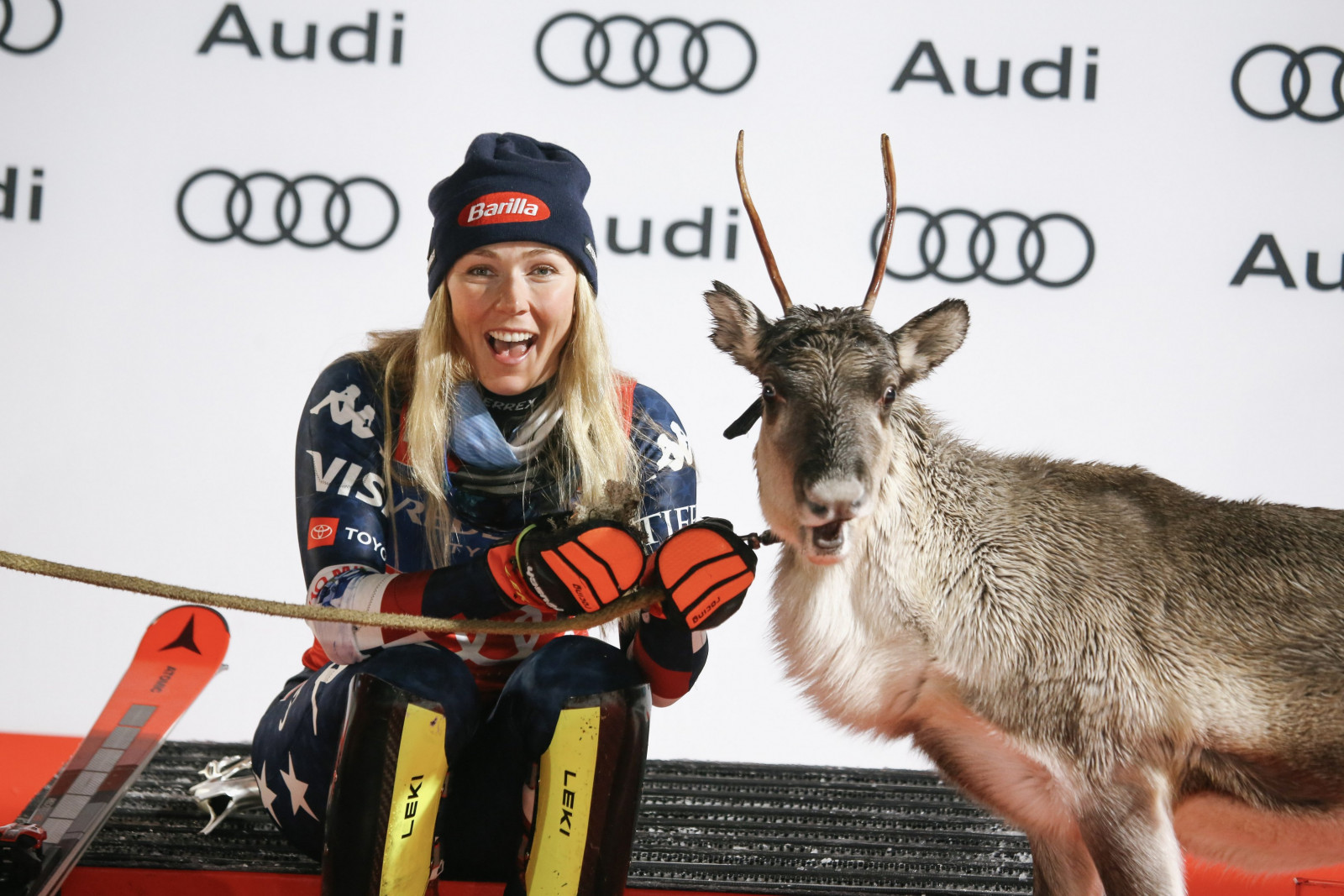
In 2013, a tradition is born at Levi. A tradition that would become one of the most iconic images of the white circus: offering a reindeer to the slalom winner. Not a classic trophy, not a crystal cup. A reindeer. A real one. Who stays in Finland, on a farm, bearing the name chosen by its godparent for a day.
That year, an 18-year-old American wins her fifth World Cup victory. Her name is Mikaela Shiffrin (USA). She would return to Levi. Again. And again. And again.
Eight times in total. An absolute record for Levi, a record that places Mikaela in second place worldwide across all disciplines for number of victories at a single site—only Lindsey Vonn and her fourteen downhills at Lake Louise do better. In pure slalom, no skier has ever dominated a venue like Mikaela Shiffrin dominates Levi.
The reindeer accumulate, each with its name. Rudolph in 2013, Sven in 2016, Mr. Gru in 2018. But it is in 2019, after her fourth victory, that Mikaela makes a major symbolic gesture by naming her reindeer "Ingemar." A strong tribute to Ingemar Stenmark (SWE), the Swedish legend whose historic record of 40 slalom victories she had just broken. The gesture is elegant, respectful. Stenmark himself salutes the performance.
In 2022, Levi exceptionally organizes two women's slaloms on the same weekend. Mikaela wins both races, earning Sunny then Lorax. Two reindeer, two names, two victories. The following year, Grogu joins the herd after the seventh victory at Levi, in particular circumstances: Petra Vlhová (SVK), leading after the first run, abandons in the second run. Shiffrin, second at the start of the final, inherits the victory.
"Oh my God, the reindeer, you never forget," Shiffrin confided after her eighth victory in 2024. "It's not good karma for me to think about the name before the race. It's always the same, I'll wait and discuss it with the team, see what everyone says."
But this time, the name leaked. Mikaela Shiffrin's eighth reindeer is called "Rori." A poetic diminutive of Aurora Borealis, the Northern Lights that dance in the Lapland sky. A nod to the place, to Arctic magic, to those nights when the sky dresses in green and purple above the snowy fjeld.
The duel with Petra Vlhová has long been one of Levi's compelling narratives. Between 2020 and 2023, the Slovak also experiences a period of remarkable domination: four victories in four years, including two doubles in 2020 and 2021. In November 2021, she even achieves one of the most impressive feats in recent Levi history: two rigorously identical podiums over two days (Vlhová, Shiffrin, Dürr), with nearly similar gaps (+0.31 and +0.84 seconds both days). Confounding consistency.
But in November 2023, during the second race, while leading after the first run by 1.41 seconds, Vlhová makes a mistake and abandons. Shiffrin, second at the start of the final, seizes the victory. A year later, injured, Vlhová is absent from Levi. The final tally stands at 8-6 in favor of Mikaela. Since 2014, only these two athletes have won at Levi—except for Tina Maze (SLO) that year.
Lena Dürr: Consistency Incarnate
While Mikaela Shiffrin and Petra Vlhová compete for victories, another athlete embodies absolute consistency at Levi: Lena Dürr (GER). The German, a discreet but formidable specialist, achieved a remarkable performance between 2021 and 2024: six consecutive podiums in six races contested.
Third in November 2021 (second race), third again during both 2022 slaloms, second then third in 2023, and finally third in 2024. Never off the podium. Never a winner either. But always there, imperturbable, absorbing the blows dealt by Shiffrin and Vlhová without ever wavering.
In 2024, at 33, Dürr even becomes the oldest woman to reach a slalom World Cup podium, breaking the record held by 2018 Olympic champion Frida Hansdotter (SWE). Exceptional longevity in a discipline where reaction speed and physical freshness often make the difference.
Katharina Liensberger (AUT), 2021 world slalom champion, also displays fine consistency at Levi with three podiums between 2023 and 2024 (third, second, second). Together, Dürr and Liensberger form the group of Levi's "permanent challengers"—those who, without dominating, never give up and maintain pressure on the favorites.
The Men's Hiatus (2020-2023)
For four years, from 2020 to 2023, men's slaloms are absent from Levi's calendar. The last men to compete in a men's slalom at the Finnish site did so on November 24, 2019. That day, Henrik Kristoffersen (NOR) wins his second Levi victory, ahead of Clément Noël (FRA, second) and Daniel Yule (SUI, third). For the young Frenchman, it is a promising first podium at Levi. Marcel Hirscher (AUT), double winner in 2014 and 2017, had retired a few months earlier. A page turns.
Then nothing for four seasons. Women continue to compete every November under the Arctic spotlights, but the men are absent. Organizers do not officially communicate about the reasons for this interruption. But by cross-referencing dates and events, the context becomes clearer.
A few years earlier, in 2015, Levi had to cancel all its races—men and women—due to an exceptionally warm autumn and critical snow shortage. This cancellation had been the trigger: as early as spring 2016, the first 30,000 cubic meters of snow were stored on Levi Black. Snow farming was born, transforming humiliation into innovation.
In summer 2019, strengthened by this now-mastered technology, Levi invests massively in its West Slopes infrastructure. An ultra-modern new lift, Levi West, is installed. The LED lighting system is completely renewed. The area is expanded, snowmaking capacity increased. The Levi Black slope, which hosts the World Cups, is part of this sector. It is re-homologated in September 2019 (number 13222/09/19).
Then comes 2020. And with 2020, the global COVID-19 pandemic. Sports seasons are disrupted, calendars reorganized in emergency, sanitary protocols impose unprecedented logistical constraints. In this context, Levi maintains its women's slaloms—tradition obliges, season opener obliges—but men's events are temporarily removed from the program.
In following seasons, the situation gradually normalizes. But Levi does not immediately add men back to the calendar. It would take until November 2024 to see them return. Four years of absence. An eternity in sports time.
On November 17, 2024, under light snow, the men finally return to Levi Black. And it is Clément Noël who wins—five years after his first Levi podium (second in 2019). The circle is complete for the French Olympic champion. Henrik Kristoffersen finishes second. And in the starting gate, surprise: Marcel Hirscher himself, back on the world circuit after five years of retirement, now under the colors of the Netherlands. The return to Levi is done in grand style.
Eduard and Jesper: The "Fearless Finns"
The announcement had the effect of a small bombshell in Finnish alpine skiing circles. For the 2025-2026 season, two Finnish names appear on men's World Cup slalom start lists: Eduard Hallberg (FIN), who has already scored 7 World Cup points in Levi (24th in the standings in 2024), and Jesper Pohjolainen (FIN). The first since Kalle Palander. Fifteen years of absence. An entire generation.
Both are part of the "Fearless Finns"—the name now borne by the men's national team. An apt name for those who dare defy geography and tackle the world circuit without the support of a centuries-old alpine tradition. Coached by Austrian Mario Rafetzeder (AUT), Eduard and Jesper earned their place on merit, via excellent results in the Europa Cup.
Last August, Jesper and his teammates pushed the logic to its limit: training in Ushuaia, Argentina, at the southern tip of the American continent. The exact hemispheric opposite of Levi. From one polar circle to another, from 67°N to 55°S, seeking snow where it exists when the Arctic summer prohibits all Nordic training. "We had three weeks of real winter conditions, icy slopes at first, then spring conditions," Jesper recounts. "Seven different slopes, quality work." From Ushuaia to Levi, the Fearless Finns travel the world to sharpen their weapons.
Eduard and Jesper are not there to be extras. They have the level, experience of continental circuits, determination. And above all, they have a dream: to ski a World Cup at home, in front of their public, on this Levi Black slope where Kalle Palander finished eleventh nearly two decades ago. "The goal at Levi is clear: make it to the second run, and there move up a few more places," Jesper confides without detour. "That would give a good snowball effect for the rest of the season."
On November 16, 2025, when they push out of the starting gate of the men's slalom, Eduard and Jesper will carry far more than a bib. They will carry a country's hope, Palander's memory, the dream of a renaissance. The pressure will be immense. The emotion too. But for Fearless Finns, fear is not an option.
In women's alpine skiing, the next generation also seems assured. Rosa Pohjolainen (FIN) represents the new generation after the Poutiainen era. The first name resonates like an echo to Tanja, like a promise of continuity. Finnish alpine skiing has never completely disappeared. It has just waited its time, patiently, under the stored snow of the fjeld.
"Chasing Dreams": Christmas Before Its Time
The theme chosen for the 2025 edition of the Levi World Cup sums up the spirit of the place in itself: "Chasing Dreams." For behind every athlete at the start, there is a long determined journey, thousands of hours of training, sacrifices, doubts, victories wrested in shadow before shining under the spotlights.
At Levi, dreams have a particular flavor. They mingle with the Northern Lights that sometimes illuminate the night sky above the fjeld. They merge with the silhouettes of 500 volunteers who, each year, bring the event to life in remarkable community commitment. They materialize in the reindeer offered to winners, living symbols of a Nordic tradition reinvented for modern sport.
And then there is Christmas. The real one. Or almost. For at Levi, in mid-November, Santa Claus himself—official resident of Finnish Lapland—makes his appearance on the podiums. Children in the stands believe it as hard as nails. Adults smile, complicit. The atmosphere is unique, between high-level competition and Arctic popular festival.
This year, the stakes exceed the usual framework. Levi's slaloms open the 2025-2026 Olympic season. In three months, in February 2026, the Milano Cortina Winter Games will distribute their medals. Every gate cleared at Levi counts double: for the standings, of course, but also for confidence, for momentum, for the push toward Italy.
"The theme emphasizes that behind every high-level athlete, there is a long determined journey," the organization explains. "But also that dreams belong to everyone—young athletes and spectators."
Eduard Hallberg and Jesper Pohjolainen perfectly embody this message. Their dream is not to reach the podium—not yet, not right away. Their dream is already realized: skiing in the World Cup, at home, in front of their people. The rest may come. Or not. But the essential is there, in those few suspended seconds between the starting gate and the finish line, under five hours of Arctic light and the benevolent gaze of Mikaela Shiffrin and her eight reindeer.
Where Legends Are Born
Levi is not just a slope. It is a laboratory of Arctic dreams. A place where geography submits to will, where the absence of mountains does not prevent excellence, where Finns write their history despite the supposed handicap of latitude.
It is also a sanctuary of consistency. Where Mikaela Shiffrin collects reindeer as others would collect trophies, with hypnotic regularity. Where Petra Vlhová, when at the height of her form, becomes untouchable. Where young Finns come seeking light under LED spotlights.
In a few days, the fjeld will illuminate again. Snow cannons will spew their crystalline mist. The 500 volunteers will take their posts. Santa Claus will don his red suit. And on Levi Black, under a sky perhaps crossed by Northern Lights, some 70 women slalom racers and 80 men will launch in pursuit of their dreams.
Some will win a reindeer. Others a place in the media sun. The Finns, they will have already won something more precious: the pride of seeing their flag flutter in the Arctic wind, carried by athletes who never stopped believing.
Under five hours of natural light, alpine skiing finds here its purest magic. That of beginnings, of traditions that are invented, of legends that are born. Welcome to Levi. Welcome where it all begins.