On 24 October in Sölden, Paula Moltzan won the season-opening giant slalom by a hundredth of a second. It was her 146th World Cup start in slalom and giant slalom. Between the first and that one came a place lost on the national team, three winters at university and summers as a rafting guide. A portrait of a lunch-pail skier, in the best sense of the word.
The split at Cortina
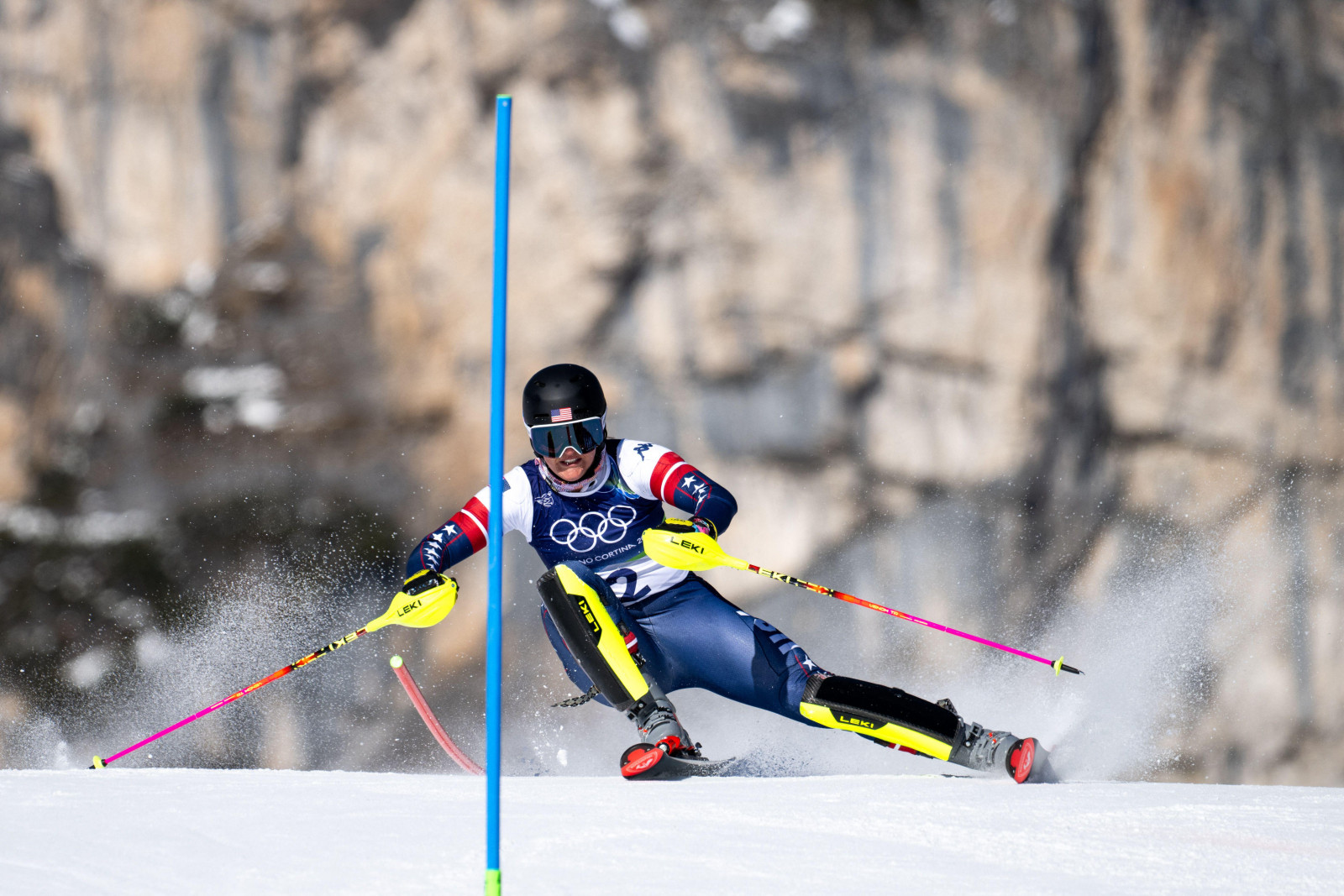
Cortina, 18 February 2026, the Olympic slalom. Paula Moltzan wears bib 2. After the first run she is only 28th, 2.77 seconds back. She was still second at the first split, then lost it all on the lower section.
In the afternoon she starts third. She sets the fastest time at every split and at the finish. Thirteen skiers come down after her without beating her. Mélanie Meillard finally knocks her off the top, by four hundredths. In the photo she has just hit a red gate and saves herself in a full split, arms wide. She never lets go, and climbs to eighth.
The whole character is in those two runs. She attacks from the gate, even if she pays for it lower down. And when there is nothing left to lose, she is the fastest skier on the hill.
Fourteen years to a win
Paula Moltzan grew up in Minnesota, on the small hill of Buck Hill, south of Minneapolis. Her first World Cup start came on 25 November 2012, in Aspen: bib 61, out in the first run. She was 18.
In 2015, in Hafjell, she became junior world slalom champion. According to Team USA, no American woman had done it before. A year later, the national team left her off its roster for the following season. Her World Cup results were not enough.
The circuit without a national team is expensive: coaches, travel, lodging. She chose college. Four days after the news, according to Ski Racing, she had a place on the University of Vermont team. She studied biology there.
In her very first season, in 2017, she won the NCAA slalom title. According to The Boston Globe, no freshman had won it since 1986. The following year she was second in slalom and third in giant slalom.
During those college years she did not ski in summer. She worked as a rafting guide in Massachusetts. According to Ski Racing, those months away from the snow gave her a solid block of fitness work.
The way back was hard-won. Before the 2019 season she talked her way into the US team’s internal qualifier for the Killington slalom. She had only five days on skis to prepare. She won it, and earned a World Cup start. At Killington, from bib 36, she finished 17th. In the spring, second place at the national championships put her back on the team.
A teammate first
Paula Moltzan has often shone for others. At the 2023 World Championships in Méribel she won the team parallel title, with Nina O’Brien, River Radamus and Tommy Ford. At the 2022 Beijing Games, the same event left the Americans just off the podium.
In 2020 she told Ski Racing: “I want you to ski well because it makes my team better.” The sentence is a mission statement.
In Cortina last February, the team she formed with Jacqueline Wiles was only fourth after the downhill. Moltzan set the fastest time at the first split of the slalom. The team led at the first two splits, then finished third. It was an Olympic bronze, 25 hundredths from gold.
River Radamus was on all four of her parallel teams, from Cortina in 2021 to Méribel. The likeness runs deeper. Neither of them makes news away from the slopes. Their private lives stay at home, and yet, at 32 and 28, they are no longer newcomers. On Sunday in Sölden he finished fourth, matching the best American result on the Rettenbach since 2015.
Savings made at the top
In Sölden, the second run told the fable. Moltzan was fastest in the first sector, then second in the next. At the second split she was 64 hundredths ahead of Lara Colturi.
The bottom cost her dearly. She was only 29th of 30 in the last sector. But she had stored up her provisions at the top. At the finish she had one hundredth left. She is Aesop’s ant, laying by in summer to last the winter.
The Ski25 database confirms the attacking streak. Over the last five seasons she has failed to finish 21% of her World Cup starts, and 27.5% in slalom. Mikaela Shiffrin, over the same period, stands at 6.3%. Moltzan does not ski to play it safe.
The season she came of age
Last winter changed everything. In the overall standings she rose from 12th to 6th. In slalom she finished in the top five seven times, against once the season before. In giant slalom she reached the podium four times, in Sölden, Kranjska Gora, Špindlerův Mlýn and Åre.
Only a win was missing. She found it where her 2026 season had begun with a second place, a year earlier. At 32, Paula Moltzan has won her first World Cup race, and she will have to be reckoned with again.
She starts this winter on new skis. After eighteen years with Rossignol, according to Le Dauphiné Libéré, she has moved to Van Deer. She is the first woman the brand has equipped, and she has given it its first women’s win.
According to Marcel Hirscher, moving into women’s racing was always part of the plan, once the brand was established on the men’s side. On choosing her, he said: “We always make sure that personality and performance potential match. Paula brings both.”
She was not looking to leave Rossignol, according to TopSkiNews. What won her over was the chance to really shape the skis she races on. And she had a point to make: “I want to show that skiing fast is much less a question of age than people generally think. I’m 32 now, but I still feel like I’m on my way to my career peak.”
The report on her win. Sölden: patient Paula Moltzan wins by a hundredth
Sources: Ski25 database (FIS results); Team USA; Ski Racing (Peter Lange, 24 June 2020); The Boston Globe (Katie McInerney, February 2026); U.S. Ski & Snowboard; Ski Racing (6 May 2026); TopSkiNews (Michel Roche, 24 August 2026); Le Dauphiné Libéré (20 August 2026); FIS (24 October 2026).