On 6 October, Sölden asked for two more races. On the 7th, its glacier was almost bare. A contradiction? Perhaps not.
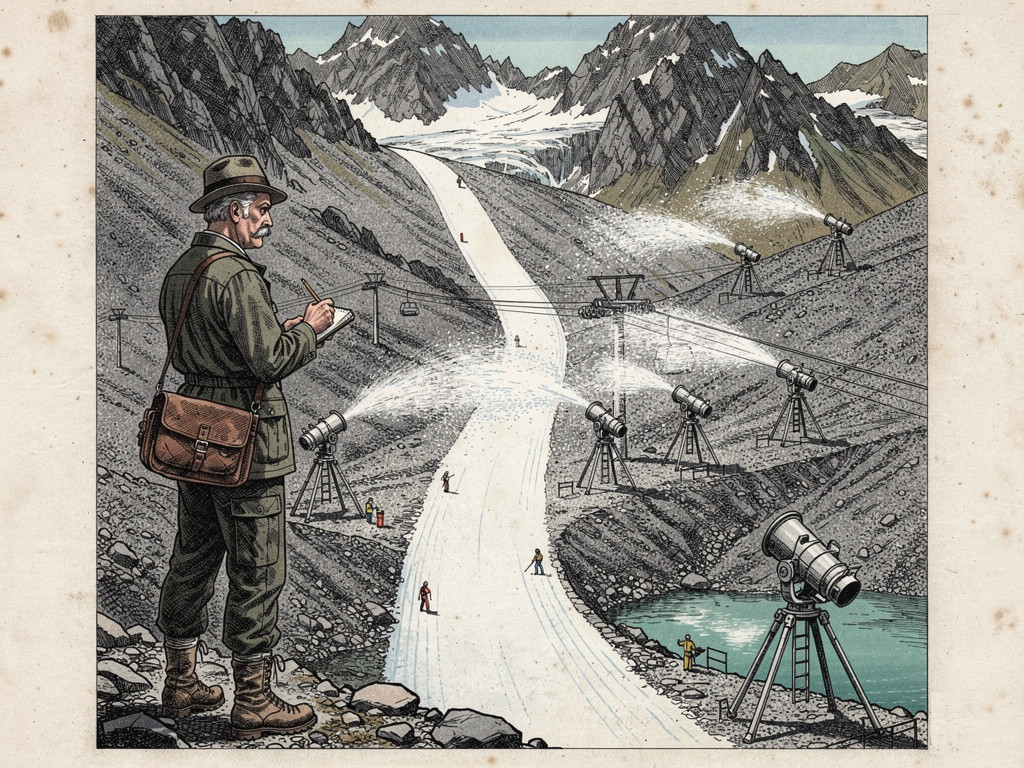
One would like to frame the two news items side by side at the entrance to the FIS offices. The first, broadcast by ORF on 6 October: Sölden wants to add two super-Gs to the two giant slaloms that open the winter, from the 2028 season. The second, reported the next day by blue News: three weeks before the races, the Rettenbach glacier is still almost bare of snow. Machines are spreading the snow set aside in spring, in five depots kept under covers all summer.
The paradox is only apparent.
The calendar as opponent
Sölden hosted its first World Cup race on 30 October 1993. Franck Piccard won the giant slalom, and Anita Wachter took the women’s race the next day. Since 2000, this is where the circuit resumes every autumn. The idea belongs to Jakob ‘Jack’ Falkner, head of the lift company, who turned a Tyrolean glacier into winter’s first fixture while the valleys below are still in autumn.
Monday 12 October, 2.20pm, on the glacier webcam: 1°C, the snow guns are running, and the course is the only white ribbon in a landscape of rock and moraine.
Nobody wins this bet against the weather for a quarter of a century without a solid sense of logistics. The five depots bear witness: here, they keep one winter’s snow for the next, as others lay down wine in a cellar or whisky in a sherry cask. According to Markus Waldner, still the FIS men’s race director at the time, there is already enough to cover the whole course with about fifty centimetres. The snow control is announced for 15 October.
Doubling the stake
I would not be surprised if the request owed less to appetite than to calculation. Two more races mean two more days, perhaps a whole extra weekend: hours of television, hotel nights, sponsors. Enough to offset what an autumn on a glacier now costs. No published statement says so. It is the reading of an observer who has watched the Austrians treat skiing as they treat everything else: pragmatically.
An objection on the way out
Markus Waldner, still in charge of the men’s races, answered without hesitation. To him, the top of the Rettenbach is too flat for a super-G.
“Es ist jetzt nicht der selektivste Hang für einen Super-G.”
One might reply that a technical super-G at the top is better than no super-G at all… All the more so as speed comes late in the calendar: the 2026 season held its first super-G only on 27 November 2025, at Copper Mountain. The 2027 season keeps to the same lines, and the women must wait until Beaver Creek, in December. Two super-Gs in Tyrol at the opener would move the clock forward by almost a month. As long as the glacier is willing.
Above all, he has another objection: a glacier in early November is no promise, and he points to the races in Zermatt, cancelled in 2022 and again in 2023. Two days later, on 8 October, he announced he would step down at the start of the season. Peter Gerdol, his counterpart for the women, and now his replacement at the head of both circuits, calls the plans interesting, provided the slope is examined. FIS has confirmed nothing.
A glacier is not a stadium
The heart of the matter lies elsewhere. A glacier is not a stadium: it is alive, it moves, it has its moods. The real question is not whether Sölden will race twice or four times. It is how many more autumns the Rettenbach will agree to launch the season. Doubling the stake may be a way of paying the insurance.
Jack Falkner is due to present his plan to the new FIS president, Alexander Ospelt, on the opening weekend. On the snow from the five depots, then. One could not dream of a better setting to plead his case, nor a worse one.
See you at the start gate.
‘Off-piste’ columns express the views of their author. The facts cited are sourced; hypotheses are presented as such.